

I used to wonder why Fluke multimeters were so expensive. But after using them for years, I get it—they’re tough, insanely accurate, and built to last. I’ve dropped mine plenty of times, and it still works like a charm.
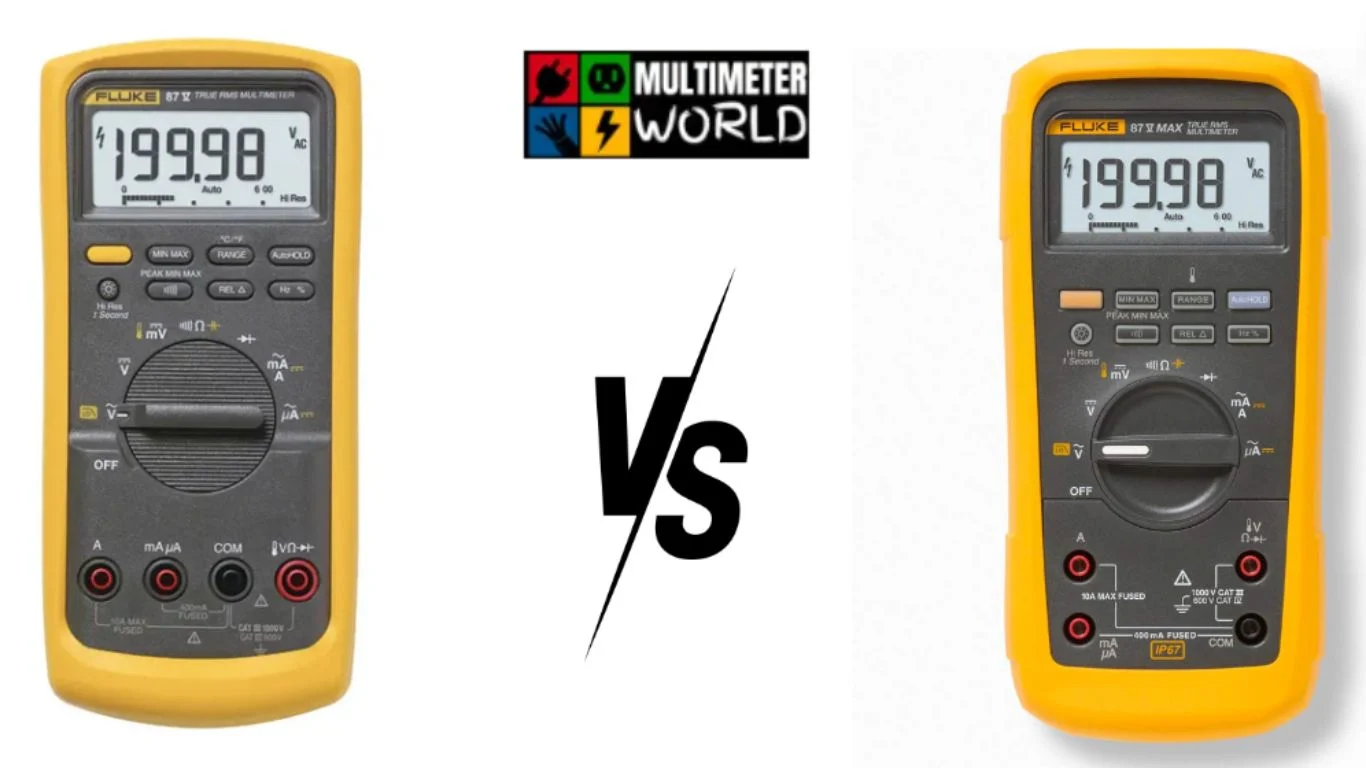
At first glance, all Fluke multimeters look similar, but they’re not. In this review, I’ll break down the Fluke 87V vs 87V Max so you can see which one’s the better buy.
A Quick Look
I’ve been using the Fluke 87V for years, and it’s been my go-to multimeter for just about everything. It’s super accurate, durable, and perfect for troubleshooting electrical systems. But if you work in harsh environments, the Fluke 87V Max multimeter might be the better choice since it’s IP67-rated and can survive a 13-foot drop.
NOCO Boost Plus GB40
⭐ 4.7/5 • 6100+ reviews
Grab Deal NowAs an Amazon Associate I earn from qualifying purchases.
Fluke Multimeters: Why Choose them?
Fluke is all about safety, designing its multimeters to protect both your equipment and you. Mistakes happen—even experienced electricians can mess up troubleshooting, which can throw off calibration or even damage a meter. But with Fluke, that’s rarely a worry since all their multimeters come with a lifetime warranty and a calibration certificate.
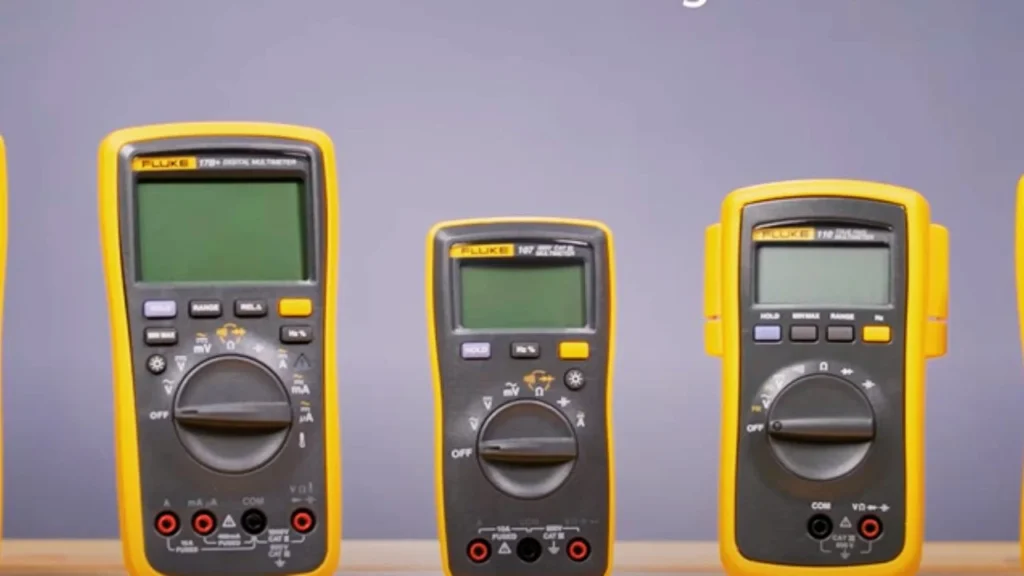
Whether it’s a basic Fluke 107 or a high-end Fluke 87V, they all have built-in safety fuses and silicone cases to keep them insulated and durable, making them a top choice for professionals. That’s why many electricians rely on the perfect Fluke multimeters to ensure accuracy, durability, and safety on the job..
Comparison Table Fluke 87v Vs 87V MAX
Fluke 87V Multimeter Review
The Fluke 87V is a reliable, high-quality multimeter for almost any electrical job, offering accurate results whether you’re troubleshooting at home or at work. However, its premium build makes it a bit expensive. If you’re looking for something more affordable, the Fluke 177 multimeter offers great accuracy and durability but lacks some high-end features of the 87V.
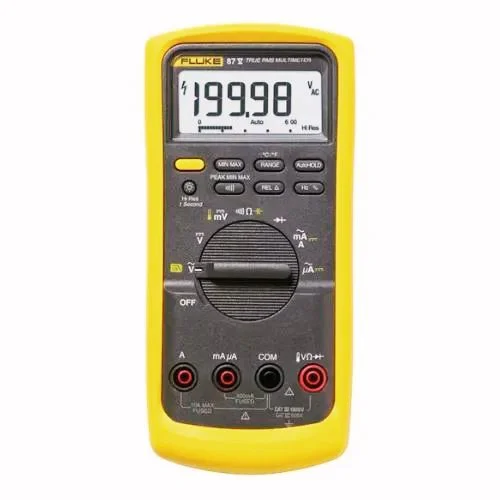
The Fluke 87V is a professional-grade tool ideal for electricians, industrial jobs, and process engineers. It’s the only meter you need for precise measurements of non-linear signals.
Furthermore, it has a CAT III 1000V rating to handle tough jobs, and a bigger display to measure values properly even in darker or confined places.
Features
- Auto-ranging digital multimeter
- LCD Display with backlit
- 6000-20000 counts display resolution
- True RMS functions
- Min/Max/Avg. Value measurements
- AC Voltage range 1000V
- DC Voltage range 750V
- Current measurement 10A
- Current can be measured upto 400 mA.
- Equipped with LPF-low pass filter.
- Analog bar graph at bottom of the display.
- Continuity and diode test with alarm.
- Temperature measurement up to –200 °C to 1090 °C
- Capacitance measurement up to 10000μF.
- Frequency Measurement in both AC/DC signals.
- Low battery indication
- Auto shutdown in case of inactivity of 15mins.
Build Quality and Design
The Fluke 87V is built to last with its silicon case for impact protection and a backlit display for dark environments. It also has separate slots for mA and ampere jacks for easier use in tight spaces.
If you’re looking for an alternative, the Klein Tools MM6000 offers a rugged design, backlit display, and great accuracy at a more affordable price, though it lacks some of the advanced features of the Fluke 87V.
Safety and Protection
Fluke 87V digital multimeter built to last. The IP30 water and dust resistance let you use it in all weather conditions. But you have to make sure that the silicon case is on the multimeter. With a 400mA Fuse and 10A Fuse, you’ll be protected from surges, spikes, and spikes of voltage resulting in burns or worse.
Moreover, this Fluke 87V meter comes With a CAT-III and CAT-IV safety rating, offering outstanding performance in a variety of applications.
Pros
- Perfect for noisy or harmonic carrying equipment.
- Display is exceptional
- Able to measure temperature.
- Works perfectly even at higher altitudes.
- Perfect for both higher and smaller voltages
Cons
- Non-Contact-Voltage detection is missing.
What is included?
- 1x Fluke 87V Multimeter
- 1x removable hostler
- 1x pair of Fluke TL75 test leads
- 1x magnetic hanger
- 1x 9V battery
Fluke 87V Max Multimeter Review
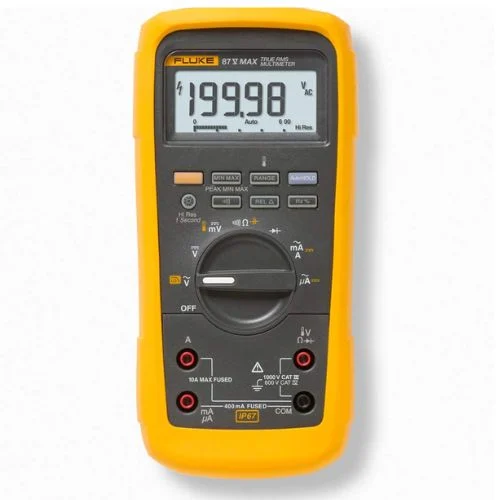
When it’s time to get your hands dirty, you need a new rugged Fluke 87V Max multimeter. These powerful and reliable meters are perfect for industrial use, with a bigger display and up to 50% faster measurements that give you more data in less time to help you make better decisions. This tough, reliable industrial meter is perfect for an electrical engineer or technician who wants the ‘ultimate’ metering solution.
Features
- An auto-ranging multimeter
- True RMS function
- Bigger LCD Display
- 20,000 counts display with backlight
- Low and Hi Brightness options in backlight
- AC/DC voltage measurements
- AC voltage range 1000V
- DC voltage range 1000V
- Current measurement in microamps.
- AC current measurement range 10A.
- Temperature measurement ranging -200°C to 1050°C.
- Frequency measurement up to 200khz.
- Capacitance measurement 10,000 microfarads.
- Continuity test with beep alarm option.
- Min/max ranges for high precision.
- Separate diode test option
- Fully water and dustproof (IP67)
- Made for industrial purposes
- 13 feet drop test certified multimeter.
- Low battery indication
- Auto shutdown in case of inactivity of 15 mins.
- Compatible with Cat-III and Cat-IV standard test leads
- Enhanced battery life due to 3x AA batteries.
Build Quality and Design
If I had to highlight the main difference between the Fluke 87V and Fluke 87V Max, it’s how the 87V Max is built for tough, industrial use. It’s designed to be waterproof and dustproof, with an IP67 rating, which I’ve found super reliable in harsh conditions.
What really sets it apart is the 13-foot drop test certification. Many multimeters cut corners when it comes to drop protection and jack insulation, but not the 87V Max. The silicon case absorbs most of the impact, so I don’t have to worry about drops or bumps.
Safety and Protection
For me, safety is key when using tools that require calibration. That’s why I trust the Fluke 87V Max—it comes with 10A fuses at the amperes jack and 400mA fuses at the mA jack, protecting both the multimeter and its calibration.
With its IP67 rating and 4-meter drop test certification, I’ve never had to worry about damaging it, even in tough environments. The test leads can handle up to 1000V AC, and I use them regularly to check DC circuits—easy and reliable.
Pros
- Good quality test leads come with it
- The battery pack also comes with the package.
- Water and dustproof rating.
- Able to measure values even at -40 degrees Celsius.
Cons
- No peripherals comes with it
What is included?
- 1x Fluke 87V max digital multimeter
- 3x AA batteries
Similarities and Differences (Fluke 87V vs 87V Max)
Similarities between Fluke 87V vs 87V Max
- Voltage measuring ranges of both multimeters are quite the same.
- Fluke 87V and 87V Max both can measure current up to 10A.
- You can measure temperature with both multimeters up to 1050°C.
- The design of Fluke 87V and 87V Max is almost similar with a slight change in silicon case.
- True RMS is enabled in both multimeters.
- Both multimeters are equipped with auto-ranging features.
- Fluke 87V and 87V Max have built-in safety fuses of 10A and 400mA.
- Test lead resistance for both multimeters is almost equal.
- Continuity test with beep alarm is available in both multimeters.
- A low battery indication is a basic option that is also available in both Fluke multimeters.
Differences between Fluke 87V vs 87V Max
- As compared to Fluke 87V, you can use Fluke 87V Max even in extreme conditions of temperature like up to -40°C to 55°C.
- Fluke 87V Max comes with an adjustable backlight brightness.
- IP67 standard is available only in Fluke 87V Max.
- You can measure mA in both, but microamperes measurement is available only in Fluke 87V Max.
- Both multimeters can endure drop tests, but Fluke 87V Max comes with a 13 feet drop test certification.
Conclusion: Which Fluke Meter To Buy?
Fluke 87V and 87V Max both fluke multimeters fall in the category of premium class. No matter you have to measure current-voltage or even temperature, you can also do any sort of electrical testing with them. But in comparison of fluke 87V vs 87V max, fluke 87V max is one step ahead of fluke 87V.
The reason is that fluke 87v max is made purely for industrial purposes to survive extreme conditions like waterproofing and drop tests. But if you’re facing such extreme conditions then fluke 87V will suit you the most. I have compared almost every feature of 87 fluke multimeters .
Frequently Asked Questions-FAQs
Can I use Fluke 87V on adjustable speed motor drives or VFDs?
As we all know, the Fluke 87V is a true RMS multimeter so you can measure non-linear loads with it easily. To measure accurate voltage the most important this is min/max ranges and this multimeter is equipped with them. Moreover, it is also equipped with low pass filters so it is quite easy to measure signals with harmonics.
How to test VFD with a multimeter?
Testing a VFD requires a lot of skills and knowledge about relevant drive configuration and multimeters. You can also test and troubleshoot any VFD by only reading its manual. I have also made a separate step-by-step guide on how to test VFD with a multimeter.
What are other electrically noisy equipment?
Every piece of equipment with an inductor or bridge rectifier has some sort of harmonic. I have encountered a lot of high-speed machines like variable frequency drives which have a lot of harmonics and noise. To reduce such noises engineers use filters ( capacitors) to filter the electrical signals.
Can I test a Thermocouple with digital multimeters?
Both the Fluke 87V and 87V max are good for temperature measurement and also come with an extended operating temperature range. You can also visit my blog about thermocouple troubleshooting and testing.
What type of frequency measurements can Fluke measure?
Fluke multimeters can do frequency measurements of both AC and DC signals depending upon drive models. Most of the mid-range fluke multimeters can measure frequency up to only 132KHz. But fluke 87V and 87V max can measure frequency up to 200KHz.