


A motor start capacitor is an essential part of an electrical system. It helps to regulate the flow of electricity, and it also has to be tested regularly to ensure it is functioning correctly. Learning how to test a motor start capacitor with a multimeter is easy but requires specialized equipment. use Milwaukee GIDDS2-288935 to test a motor start capacitor in your home or business.
| Quick Look: Testing a motor start capacitor is something I find essential to keep my motor running smoothly. With a multimeter, I can easily check for shorts, resistance, and capacitance, helping me spot issues quickly. By following a few simple steps, I can diagnose problems and avoid unnecessary replacements. |
Motor Start Capacitor Testing Summary Table
How To Test A Motor Start Capacitor | Step By Step Guide

Things You Will Need
The first step in testing a motor start capacitor is to gather the appropriate tools and materials.
A Quick Look
You’ll need a multimeter, which measures voltage, current, and resistance
NOCO Boost Plus GB40
⭐ 4.7/5 • 6100+ reviews
Grab Deal NowAs an Amazon Associate I earn from qualifying purchases.
- Wire cutters
- Insulated gloves
- An adjustable wrench
- Safety glasses
Make sure that all electrical connections are disconnected before beginning the testing process. Once you have the proper tools, you can start testing the capacitor.



Procedure

Step 1: Unplug your motor from the wall outlet before doing anything else. This is an important safety measure that must be noticed.
Step 2: Locate the capacitor on the motor. It should be cylindrical, with two electrical terminals coming from one end and a rubber cover on the other. The rubber cover will need to be removed to access the terminals. For testing the voltage on the capacitor, you can use a voltmeter to ensure that the capacitor is functioning correctly.
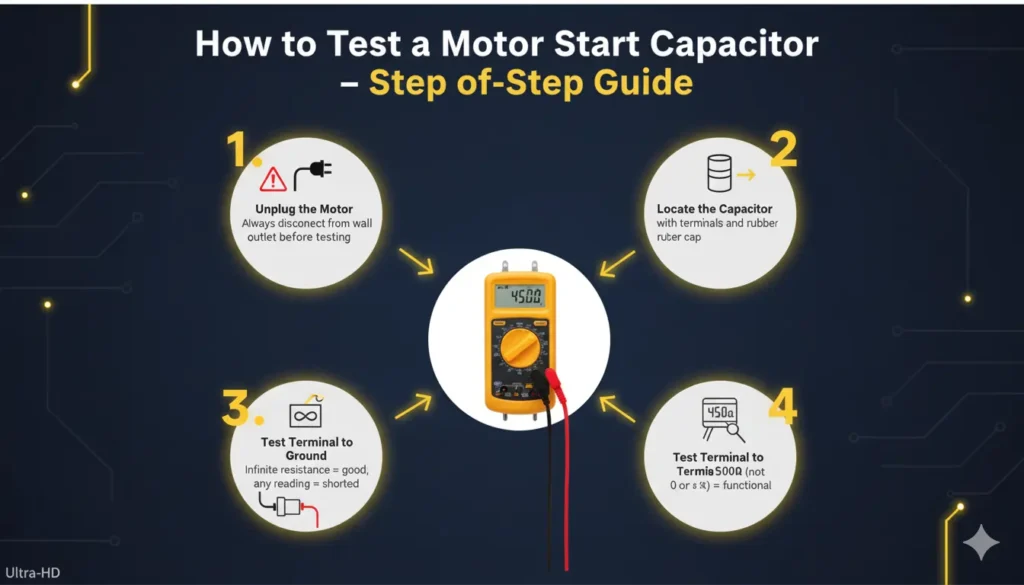
Step 3: Use an ohmmeter to measure the resistance between each terminal and the ground (the capacitor’s body). The reading should show infinite resistance, in other words, no connection between each terminal and the ground. If there is any connection, this indicates a short circuit within the capacitor, and it needs to be replaced. For more detailed guidance, check out how to test a motor start capacitor with a multimeter, which can help you accurately assess its condition.
Step 4: With your ohmmeter still connected, measure the resistance between each terminal and one another. The reading should be lower than 500 ohms, but not zero or infinity (if it’s either of those, then again, you’ll need to replace the capacitor). If this reading is too high, it could indicate too much capacitance in the system, which can cause excessive current draw when starting up your motor.
What Are The Indicators If The Capacitor Is Not Working?

Identifying a capacitor that is not working can be tricky. Generally, it is difficult to tell whether a capacitor is broken by looking at it. To accurately diagnose the issue, you need to check a DC motor using an ohmmeter or multimeter. If the component isn’t working correctly, the meter will measure no resistance, which indicates a short circuit in the unit. In this case, it’s been damaged and needs to be replaced. Another possible indicator of non-functioning capacitors is a change in capacitance when tested. Whenever this occurs, it’s inevitable that the component has gone bad and must be replaced for normal operations to resume.
What Causes A Motor Start Capacitor To Fail?
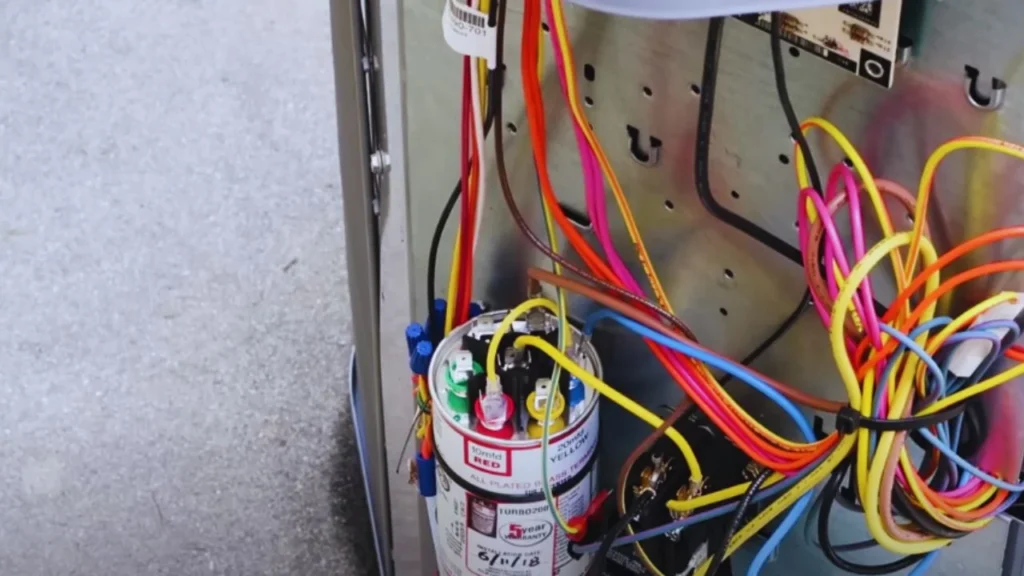
Motor start capacitors are electrical devices that help motors draw a high current when starting. They are commonly used in air conditioners, refrigerators, and other large appliances. While these capacitors can last for many years, they will eventually fail due to wear and tear. Let’s take a closer look at what causes motor start capacitor failure and how it can be prevented. For testing and diagnosing electrical components, you might find tools like the Fluke 15B multimeter particularly useful.
Age
The most common cause of motor start capacitor failure is age. Over time, the electrolyte inside the capacitor loses its ability to hold a charge, resulting in the loss of power that enables the motor to run efficiently. This type of wear-and-tear is simply unavoidable; even if you take excellent care of your capacitor, there will come a time when it needs to be replaced due to age alone.
Corrosion Or Oxidation On The Terminals
Another common cause of motor start capacitor failure is corrosion or oxidation on the terminals or connections. This can occur due to moisture from condensation or exposure to corrosive gasses and liquids such as those found in specific industrial environments. Corrosion can prevent the capacitors from connecting effectively with the circuit board, resulting in reduced performance and eventual failure. To avoid this, it’s essential to understand how to test a motor start capacitor with a multimeter, as this can help identify potential issues early and prevent further damage.
Overvoltage Or Undervoltage

Finally, one of the most damaging causes of motor start capacitor failure is overvoltage or Undervoltage conditions in the power supply line. Too high or too low voltage can cause arcing or sparks within the capacitor, which damages its internal components and leads to premature failure. It is essential to ensure that your power supply voltage remains within acceptable limits to prevent this catastrophic damage.
Bottom Line:
Now you have an idea about how to test a motor start capacitor. Testing your motor start capacitor is a reliable way to determine whether or not any issues are causing the inefficient performance of your motor system. By taking a few simple steps with an ohmmeter, you can quickly diagnose problems with your capacitor so they can be fixed quickly and easily – saving you both time and money! Whether you’re a DIY enthusiast or an experienced professional, this guide will help make testing a breeze so you can get back up and running as soon as possible! For accurate testing, tools like the Amprobe AM-510 multimeter can be extremely helpful.
FAQs
Q1: How do I test a motor start capacitor with a multimeter?
To test a motor start capacitor, you’ll need to use a multimeter with an ohmmeter function. Start by measuring the resistance between each terminal and the ground. Ideally, you should see infinite resistance, which means there’s no connection.
If you notice a resistance reading close to 0 ohms (a short circuit), or if the resistance is higher than 500 ohms but not infinite, the capacitor is faulty and should be replaced.
Q2: What are the signs that a motor start capacitor is faulty?
A faulty motor start capacitor can present several signs. First, a reading of 0 ohms (no resistance) when tested with an ohmmeter indicates a short circuit inside the capacitor. A resistance reading above 500 ohms but below 1,000 ohms might suggest that the capacitor is deteriorating but hasn’t fully failed.
Additionally, if there is a noticeable change in capacitance (such as more than a 10% deviation from the rated capacitance), it could mean the capacitor’s ability to start the motor has been compromised.
Q3: Can I test a motor start capacitor without a multimeter?
While a multimeter is the most accurate tool for testing, there are some visual signs of a faulty capacitor that you can check without a multimeter. Look for physical damage such as bulging, which may occur by 5-10% of the capacitor’s original size, or leaking fluid.
However, for precise testing of capacitance, resistance, or voltage, a multimeter with a capacitance function (measured in microfarads, μF) is necessary to get a complete diagnosis. If you’re unsure how to test a motor start capacitor with a multimeter, following the proper steps can help you confirm whether the capacitor is faulty or functioning properly.
Q4: What causes motor start capacitors to fail?
Motor start capacitors can fail for several reasons. One of the most common causes is age, typically after 5-10 years of use, as the electrolyte inside the capacitor loses its ability to hold a charge. Corrosion or oxidation on the terminals, often caused by exposure to moisture or corrosive substances, can also lead to failure by preventing a proper connection.
Additionally, overvoltage or undervoltage conditions can significantly damage capacitors. Exposing the capacitor to voltages above 250 volts or below 90 volts can cause arcing or sparks inside the capacitor, leading to premature failure.