


Are you a practicing engineer or an enthusiast looking for the 5 best Fluke multimeters for electrical engineering? If so, then you’ve come to the right place! Choosing the appropriate tools for any technical task is critical; however, selecting suitable measuring equipment like a reliable and accurate digital multimeter for testing, diagnostics, and troubleshooting is even more essential.
With that in mind, our product specialists have compiled this specially curated list of five of the finest Fluke multimeters available today. However, each device has been carefully selected based on performance and specifications to assist you in finding your ideal meter.
A Quick Look
So whether you’re new to electrical engineering or have been involved with it since long before we all became friends here at multimeter world, read on to discover our hand-picked selection of these top five fluke meters!
NOCO Boost Plus GB40
⭐ 4.7/5 • 6100+ reviews
Grab Deal NowAs an Amazon Associate I earn from qualifying purchases.
| Quick Look: When I was looking for the best Fluke multimeters for electrical engineering, I found these five top picks. The Fluke T5-600 is great for closed-loop testing, while the FLUKE 17B+ is perfect for routine use. For industrial work, I recommend the Fluke 1587/I400 FC, and the Fluke 15b+ is my go-to for electronics work. |
How To Choose The Best Fluke Multimeter For Electrical Engineering
Choosing the best Fluke multimeter for electrical engineering is a big decision, and knowing what to look for can be difficult. In this guide, we’ll also take you through all the important considerations in making an informed decision about which model is right for your needs.
First and foremost, it’s essential to know exactly why you need a multimeter in the first place. While most people use them as part of their everyday toolkit for electrical repairs or maintenance/installation work, there are plenty of other uses beyond just checking continuity or live testing circuits.
Here are some examples of how different professionals might use a multimeter in their day-to-day occupations:
- Electrical engineers use them to measure voltages and currents during research projects or troubleshoot existing setups.
- Mechanics use them to test automotive components like alternators, starters, and spark plugs
- HVAC technicians use them to check the amperage draw on air conditioner motors as well as trace heating elements throughout ductwork systems
- Contractors use them when working with new construction sites or doing home remodels
Each of these scenarios requires its own set of features from a multi-meter—so it pays off numerous times over to do your homework ahead of time to ensure you’re getting exactly what you need from the device itself.
Other Aspects
Once you have an idea about why exactly you require this type of device and what specific tasks it will be used for, then you can move on to consider some other practical factors, such as display size (which impacts your ability to read data quickly) plus necessary protection against electric shock/spikes (IEC 61010). Meanwhile, if portability is paramount, smaller models with integrated probes may be more appropriate than larger varieties requiring third-party accessories (e.g. long leads).
Brand Consciousness
Regarding brand name recognition amongst gadget aficionados within any given field, the market leader has long been Fluke Corporation, producing quality devices since its founding back in 1948 – although similar products by competitors such as Extech Instruments Corporation do hold close feature comparison too. (reference) It should also come as no surprise that professional recommendations would almost always consider their highest-end product lines before suggesting anything else– while still being mindful that “you get what you pay” here holds even among top-shelf options. (reference) Lastly, remember, when looking into any multimeter purchase, warranty coverage concerns should always be considered – so make sure whatever model chosen offers support services nearby whenever possible(reference).
To sum up, choosing the ideal fluke Multimeter ultimately comes down to several closely intertwined decisions about personal preferences versus technical specifics. If one remains aware of these core criteria, including purpose /usage requirements, display size, portability, safety ratings, brand credentials, and applicable warranties. Moreover, anyone shopping around this sort of equipment should find themselves heading toward the perfect solution no matter the budgeted costs.
Top 5 Best Fluke Multimeters For Electrical Engineering
1. Fluke T5-600 Electrical Tester- Best for Closed Loop Testing

The T5-600 Electrical Tester from Fluke can do it all! Not only can you check the AC/DC voltage up to 600V, but you can also test continuity, current and more. OpenJaw current technology allows you to measure current without breaking the circuit, making your job easier. For added convenience, the test leads stow away neatly in the back of the tester.
An optional holster attaches easily to your belt for a secure fit. And don’t worry about accidental drops – this tough little device is engineered to withstand a 10-foot drop! All these powerful features come with safety certifications, including UL, CSA, CE, and VDE standards, so get ready to upgrade your toolkit with Fluke’s T5-600 Electrical Tester!
The Fluke T5-600 Electrical Tester is a remarkably versatile tool. Its features range from AC up to 100A, continuity of fewer than 25 ohms, 1000 ohms resistance, and 45 to 66 Hu Calibration frequency. Its 0.5-inch jaw capacity and 1000 counts make it an excellent choice for precision measurements. However, if you need a Fluke T5-1000 or T6-1000 then we have also made an in-detail comparison of these amp clamp meters.
Furthermore, auto-ranging, audible continuity, data hold, and auto power-off features make this tester incredibly easy to use. The LCDs provide clear visibility for reading results with a high level of accuracy: +/ 1.5 percent + 2 digits. With an impressive operating temperature range of 14 to 122 degrees Fahrenheit, the Fluke T5-600 is appropriate in any work environment — plus its safety-rated CAT III 600V. And included in the package is all you need to get started: two AA batteries and an instructions guide!
Specifications:
- Auto/Manual ranging: Yes
- AC/DC Voltage measuring range: 1000V
- AC/DC Current measuring range: 100A
- Resistance: 1000Ω
- Drop Tested: Upto 3 Meteres (10ft)
- Frequency: 45 to 66 Hz
- Capacitance: N/A
- Temperature: N/A
- CAT Rating: CAT III & IV
- Warranty: 2 year
What Works?
- Automatically measures volts: Saves time with quick, accurate readings for routine checks.
- Easy and accurate: User-friendly and reliable for both beginners and pros.
- Can stay connected longer: Great for extended projects without losing connection.
- LCD display: Clear and easy to read in bright environments.
What Doesn’t Work?
- Automatic voltage measurement: Lacks manual control for detailed tasks.
- LCD display: No backlight, hard to read in low-light conditions.
Why?
- The automatic voltage measurement is efficient for quick checks but not ideal for precision tasks.
- The LCD display works well in good lighting but struggles in dim environments, making a backlit option a better choice for low-light situations.
2. FLUKE 17B+ Digital Multimeter – Best for Routine Use
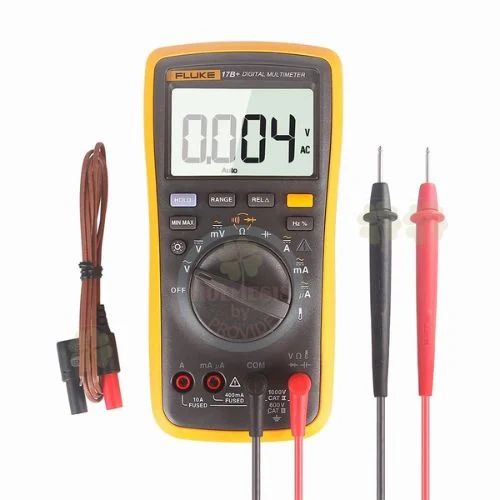
The Fluke 17B+ Digital Multimeter is an incredibly versatile device. It offers an impressive array of functions, including frequency, temperature, AC/DC voltage/current measurement, capacitance, diode and continuity testing, and duty cycle testing. Frequency ranges extend from 50Hz to 100KHz, and temperatures range from -55C to 400C.
Built-in features include auto-ranging capabilities, a large LCD display that updates at 3/sec, overflow indication, and over-range protection. Additionally, the convenient carrying case provides a safe and secure way to transport this invaluable tool. With its comprehensive selection of advanced features and robust design, the Fluke 17B+ Digital Multimeter is the perfect choice for measuring instruments that require precision and accuracy.
Specifications:
- Display Counts: 4000
- Auto/Manual ranging: Yes
- AC/DC Voltage measuring range: 1000V
- AC/DC Current measuring range: 10A
- Resistance: 40 MΩ
- Frequency: 50Hz to 100Khz
- Capacitance: 0.01nF to 100uF
- Temperature: -55C to 400C
- CAT Rating: V CAT III
- Warranty: Lifetime
What Works?
- User-Friendly Design: I found it easy to use with an intuitive interface, which stood out compared to other models I’ve tried.
- Carrying Case: The included carrying case kept everything organized, something many competitors lack.
- Clear Display: The screen was easy to read, even in low light—better than many alternatives I’ve tested.
- Heavy Duty Build: It’s built to last, feeling more durable than other models that didn’t hold up as well.
What Doesn’t?
- No Magnetic Strip Holder: I missed having a magnetic strip holder, which competitors offer for hands-free use. Without it, I had to hold or place the device down, which wasn’t as convenient.
3. Fluke 114 Electrician’s Multimeter – Best for Commercial Use
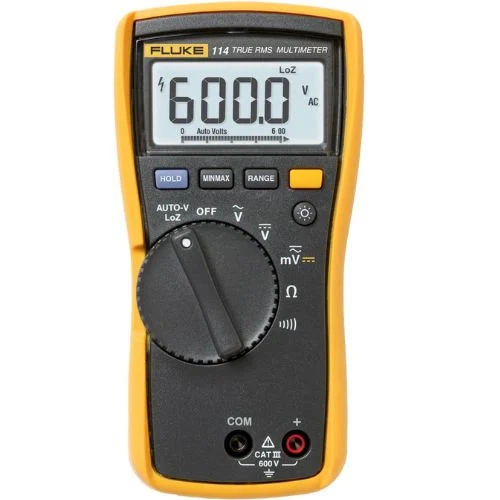
The Fluke 114 True RMS digital multimeter makes troubleshooting easier than ever before. Its innovative AutoVolt function quickly and automatically selects AC or DC voltage, while the LoZ setting helps you avoid potential false readings by identifying ‘ghost voltage’.
Additionally, this device also offers a loud audible continuity test and displays True RMS readings with a 6000-count resolution. Moreover, it comes fitted with a large white LED backlight, allowing you to work in even poorly lit areas. Professionals who need to work in CAT III 600V environments will be relieved that the Fluke 114 has been tested for safety in these settings.
Specifications:
- Display Counts: 6000
- Auto/Manual ranging: Yes
- AC/DC Voltage measuring range: 600mV
- Resistance: 6.000 MΩ
- Frequency: 50Hz
- Temperature: 10 C to + 50 C
- CAT Rating: CAT III 600V
- Warranty: 3 year
What Works?
- Automatic Shut-Off: I found the automatic shut-off feature great for saving battery life, especially when I forget to turn it off.
- Low Input Impedance: It prevents false readings, ensuring more accurate results when testing.
- Easy Battery Access: The easy-open door made battery changes quick and hassle-free.
- LED Display: The large, backlit display was clear and easy to read, even in low light.
What Doesn’t Work?
- No Current Measurement: I noticed it doesn’t measure current. Compared to other models, this limits its versatility for more complex tasks.
4. Fluke 1587/I400 FC 2-In-1 Multimeter With Clamp – Best for Industrial use

The Fluke 1587/I400 FC 2-in-1 insulation multimeter with clamp is an invaluable asset when it comes to tough jobs in harsh working conditions. This digital multimeter has an IP 67 (waterproof and dustproof) rating that exceeds industry standards. Its extended operating temperature range of -15°C to +55°C and 95% humidity allow it to function reliably in severe temperatures.
With a 3 m (10 ft) drop test rating, this multimeter stands up to drops and other impacts without a hitch. The Fluke 1587/I400 FC 2-in-1 insulation multimeter is the perfect choice for professionals who need an accurate and reliable tool for electrical troubleshooting in even the most challenging environments.
The Fluke 1587/I400 FC 2-In-1 Insulation Multimeter with Clamp is an incredibly versatile and accurate instrument that makes the work of electricians and maintenance technicians much more efficient. It can measure up to 1000V AC and DC, 10A (20A for 30 seconds), 10,000μF capacitance range, and frequency up to 200kHz, and it has a built-in thermometer, so you don’t need to carry a separate instrument.
In addition, it also runs a resistance, continuity, and diode test, perfect for diagnosing problems quickly and accurately. Recording results is simple, too; it automatically captures variations via Min/Max and average recording capabilities. In short, this is one meter you want in your toolbox for the widest range of electrical testing jobs.
Specifications:
- Display Counts: 6000
- Auto/Manual ranging: Yes
- AC/DC Voltage measuring range: 1000V
- AC/DC Current measuring range: 400 mA
- Resistance: 50 MΩ
- Frequency: 99.99 kHz
- Capacitance: 9999 μF
- Temperature: -15°C to +55°C
- CAT Rating: CAT IV 600 V / CAT III 1000 V
- Warranty: 1 year
What Works, What Doesn’t, and Why?
Memory Storage
What Works: In my experience, the memory storage is really handy for keeping data.
What Doesn’t: However, I noticed that some models have more storage, which is crucial if you’re working with larger datasets.
Temperature Compensation
What Works: The temperature compensation kept my readings accurate even with fluctuating temperatures.
What Doesn’t: But, I found that other devices handle extreme temperature changes better, offering more consistent results.
Built-in Thermometer
What Works: The built-in thermometer was super convenient for quick checks.
What Doesn’t: From my research, some alternatives have more advanced thermometers for greater accuracy, so they might be better for precise readings.
Soft Case
What Works: I liked the lightweight and portable soft case for easy carrying.
What Doesn’t: However, it didn’t offer much protection from drops, so a hard case might be a better option for durability.
5. Fluke 15b+ Digital Multimeter – Best for Electronics Work

The Fluke 15b+ Digital Multimeter is an incredibly innovative tool for electricians, engineers and hobbyists. This multimeter packs multiple readings into one device and features auto and manual ranging. With a large LCD display and the ability to use 4,000 counts of data at three seconds per update, this digital multimeter offers precise readings no matter the job.
This meter has four frequencies from 50Hz to 100Khz, so you don’t have to worry about missing a detail due to lack of range. From DIY projects to engineering jobs where accuracy matters most, the Fluke 15b+ Digital Multimeter will provide accurate readings regardless of application.
Moreover, the Fluke 15b+ Digital Multimeter is the perfect tool for anyone working with electronics. Not only does it measure voltage, but also temperature, ranging from -55C to 400C. Moreover, this handheld device is compact and lightweight yet incredibly durable, measuring 180 x 89 x 51.5mm. With its vibrant orange colour, the Multimeter stands out among other devices and will surely be an eye-catching addition to any workbench.
Specifications:
- Display Counts: 4000
- Auto/Manual ranging: Yes
- AC/DC Voltage measuring range: 1000V
- AC/DC Current measuring range: 10A
- Resistance: 40 MΩ
- Frequency: 50Hz to 100Khz
- Capacitance: 1000 μF
- Temperature: -55C to 400C
- CAT Rating: 600V CAT Ⅲ,1000V CATⅡ
What Works?
I found the product super easy to use, with no complicated setup required, which was a huge plus for me. The accuracy was spot on every time, delivering reliable results. The durability stood out too; it’s built to last and held up well during rough handling. Plus, the multiple functions really made it versatile for different tasks.
What Doesn’t?
While it’s easy to use, I noticed that it might feel too basic for users who prefer more advanced features. The accuracy is great, but compared to other high-tech options, it’s not the most cutting-edge. It’s durable, but the broad versatility may not be ideal if you’re after something specialized. And while the extra functions are useful, they might be unnecessary if you only need one feature.
Why?
The simplicity works well for those who need something quick and easy, but it may not satisfy those wanting more control. The accuracy is reliable, but it lacks the advanced tech some higher-end models offer. It’s durable and versatile, making it a great all-around tool, though not the best choice for highly specialized needs. The extra functions are great if you need them, but they might just be extra bulk if you’re after something simpler.
Bottom Line
The Electrical Engineering world is one of the essential engineering disciplines, and a good Fluke multimeter is an invaluable tool for any engineer. We also hope our list of the 5 Best Fluke Multimeter For Electrical Engineering has helped you find the right one for your needs. If you have any questions or suggestions, feel free to comment below!
FAQs
1. What is the Difference Between True RMS and Regular Multimeters?
True RMS (Root Mean Square) multimeters provide more accurate readings when measuring AC signals, especially those that are not pure sine waves. Regular multimeters might give inaccurate or misleading readings when measuring complex or distorted waveforms. True RMS is essential for getting precise voltage and current readings in modern electronics, motors, and devices that use non-sinusoidal signals.
2. Can I Use the Fluke 1587/I400 FC for Both Industrial and Home Use?
Yes, the Fluke 1587/I400 FC is versatile and can be used for both industrial and home use. It combines a digital multimeter and a clamp meter, making it ideal for heavy-duty industrial tasks, as well as everyday electrical troubleshooting at home. Its advanced features, like the ability to measure both voltage and current with high accuracy, ensure it works well across various applications.
3. Which Fluke Multimeter is Best for Electronics Work?
For electronics work, the Fluke 15b+ is an excellent choice. It features True RMS measurement for accurate results, even in non-sinusoidal waveforms, and is compact and durable enough for everyday use. Whether you’re troubleshooting circuit boards, measuring small components, or working on repair projects, the Fluke 15b+ is reliable and precise.
4. How Accurate is the Fluke 114 for Commercial Use?
The Fluke 114 is highly accurate for commercial use, offering a 6000-count display and True RMS capabilities for accurate voltage and current readings. This multimeter also features auto-ranging, which simplifies measurements for both beginners and experienced electricians. It’s ideal for various commercial tasks, from wiring in offices to maintenance on electrical systems.