


Are you looking for an accurate and reliable multimeter to help with your electronic projects? Then the Fluke brand is just what you need, as they are renowned for their top-of-the-line quality. Keep reading to get the 5 Best Fluke Multimeters for Electronics Work.
With a wide range of multimeters available for purchase, choosing the right one for your needs can be tricky. Although to make things easier, we’re compiling a list of the five best Fluke multimeter models to help you get started on finding yours. Here’s everything that you need to know about them!
A Quick Look
| Quick Look: When I work on electronics, I trust the Fluke 87V/E2 Combo Kit for its reliability in industrial settings. For advanced diagnostics, the Fluke-279FC/IFLEX is my go-to. The Fluke 1587 FC offers great versatility, while the Fluke 115 and Fluke 117 are perfect for everyday tasks, providing accurate and easy measurements. These tools make my work faster, more efficient, and give me the confidence I need for every job. |
How To Choose The 5 Best Fluke Multimeters for Electronics Work?
Choosing the best Fluke multimeter for electronics can be overwhelming, as many different types and models are available on the market. However, if you keep a few key points in mind when making your selection, you’ll be able to find the perfect multimeter for your needs.
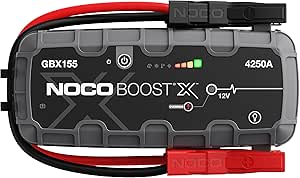
NOCO Boost Plus GB40
⭐ 4.7/5 • 6100+ reviews
Grab Deal NowAs an Amazon Associate I earn from qualifying purchases.
Features
First, it’s essential to think about what features are most important to you. Different Fluke models offer a range of parts, including DC voltage measurements, AC current measurement ranges up to 10 A (amps), temperature measurement capabilities, and diode testing capabilities.
Some units also have additional features, such as an LCD display with backlighting and auto-ranging capability. Consider which specific functions you will need most and prioritize them according to importance in order to narrow down your choices accordingly.
Quality Material
Second, consider build quality when assessing potential models – not all multimeters are created equal! A good quality model will have strong insulation resistance ratings and long battery life so that it doesn’t require frequent replacement or calibration, likely due to poor electrical connections or components wearing out quickly from use over time.
Also, look at different operational modes available depending on whether average reading values over time or specific moments in time readings are needed, e.g., peak hold mode vs. normal operation mode or manual vs. auto-ranging, etc… Doing research beforehand will ensure that you pick the model best suited for your needs instead of having buyer’s remorse later on!
Price
Finally, price should also come into play when choosing a suitable model for yourself. However, its not just about sticker price; higher priced options often include added benefits like better warranties or more comprehensive user manuals that might make spending extra money worth investing in, especially if getting help is a high priority, i.e., one milliammeter might cost $100 less than another but doesn’t come with customer support/community forums / downloadable documentation, etc.
Ultimately aim at finding value rather than going solely based on the lowest prices – this last point applies universally across any consumer purchasing decision, after all! Good luck with picking out yours & hopefully, this guide has given some valuable insights.
5 Best Fluke Multimeters For Electronics Work- Top Picks
1. Fluke 87V/E2 Combo Kit -Most Reliable Industrial Electrician Kit

The Fluke 87V/E2 Industrial Electrician Combo Kit is an indispensable tool for the modern electrician. This also highly versatile device is perfect for any job, big or small, featuring a built-in thermometer, true-RMS ac voltage, current capability, and measurement readings up to 1000 V AC and DC.
With its unique function designed to measure accurate voltage and frequency on adjustable motor drives, it’s sure to have you covered no matter what the electrical situation. Moreover, the large digital display with a bright two-level backlight ensures that all results are easily visible, clear, and concise, allowing you to finish your tasks quickly and confidently.
Working with VSDs/VFDs, industrial troubleshooting, and power quality. Sounds like a tall order, but it doesn’t have to be. The Fluke 87V/E2 Industrial Electrician Combo Kit can help you tackle all of these tasks. With its ability to take accurate voltage, current, and frequency measurements on the output side of the drive at either the drive itself or at the motor terminals, you’ll find more resolution and accuracy than you ever thought possible. And with its optional magnetic hanger for easy set-up and viewing, enabling you to identify even the shortest 300 μs glitches and spikes, quickly freeing your hands for other tasks – this is one powerhouse kit that will help you get the job done!
Specifications:
- Display Counts: 19,999
- Auto/Manual ranging: Yes
- AC/DC Voltage measuring range: 1000V
- AC/DC Current measuring range: 10A
- Resistance: 50 MΩ
- Frequency: 0.5 Hz to 199.99 kHz
- Capacitance: 10,000 μF
What Works, What Doesn’t, and Why:
- What Works: Built-in Thermometer
The built-in thermometer is a standout feature. It saved me time when working with components that need precise temperature control. Compared to other multimeters, having this feature integrated made things much more convenient. - What Doesn’t Work: Durability of the Case
The case isn’t durable. After a few months of use, I noticed signs of wear, which was disappointing since I often carry my tools around. For better protection, I’d recommend getting a separate case or opting for more rugged models like Fluke. - What Works: Large Digital Display
The large display is easy to read, even from a distance. It made working in low light much easier and eliminated the need to squint or adjust the tool constantly. It’s a big plus for efficiency.
Why This Matters?
In my experience, this multimeter is reliable with its accuracy and large display. However, the weak case might be an issue if you’re always on the move. If durability is important, consider alternatives like the Fluke 87V.
2. Fluke-279FC/IFLEX 279FC Digital Multimeter
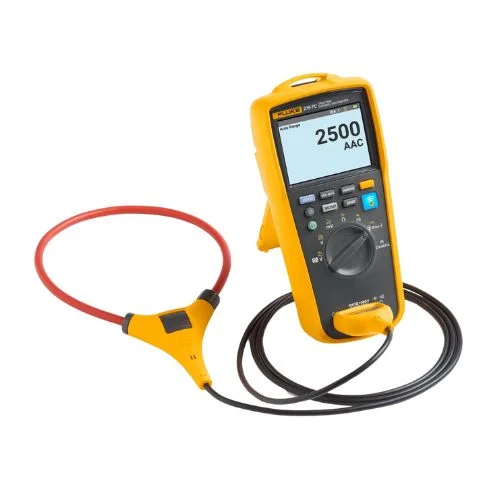
The Fluke-279FC/IFLEX 279FC Digital Multimeter is the new gold standard in thermal imaging multimeters. It is a perfect tool for any electrician to use when troubleshooting electrical equipment issues. This easy-to-use device can detect hot spots on high-voltage equipment and transformers, as well as spot heating fuses, wires, insulators, connectors, splices, and switches.
No longer do electricians need to carry separate tools—this thermal multimeter combines everything. Also compatible with iFlex, a flexible current clamp that allows users to measure current up to 2500 A AC in hard-to-reach spaces. All viewing is made easier with its sizeable full-color LCD display. With the Fluke-279FC/IFLEX 279FC Digital Multimeter in hand, electricians can get the job done faster and more safely than ever before!
Furthermore, the Fluke-279FC/IFLEX 279FC Digital Multimeter brings efficiency and convenience to electrical maintenance operations with its long 10-hour rechargeable battery, wireless transmission capabilities, and Fluke Connect built-in.
By transmitting data directly to a smartphone, field workers can drastically reduce the time spent on reporting and validating work. Moreover, they can also access the trending and monitoring features of the multimeter right on their phone screen for faster troubleshooting. The added bonus is that reports can even be created and emailed straight from the field too!
Specifications:
- Display Counts: 6000
- Auto/Manual ranging: Yes
- AC/DC Voltage measuring range: 1000V
- AC/DC Current measuring range: 2500A
- Resistance: 50 MΩ
- Frequency: 100 kHz
- Capacitance: 9,999 µF
What Works?
- Built-in Thermal Imager:
I found the thermal imager really handy for spotting overheating components. It saved me time by allowing me to identify issues quickly without a separate camera.
Why it works: It streamlines diagnostics, especially for complex electrical problems. - Fluke Connect Compatibility:
Fluke Connect allowed me to monitor and share readings remotely, which was a game-changer when I worked in tight spaces.
Why it works: It boosts efficiency by letting you track data without being physically present. - Full-featured Multimeter:
With 15 functions, this multimeter handled everything I threw at it—voltage, current, resistance—making it perfect for varied tasks.
Why it works: The versatility makes it a one-stop solution for many electrical measurements.
What Doesn’t Work?
- No Thermocouple Measurement:
When I needed to measure a thermocouple during an HVAC job, I realized the tool doesn’t support it. I had to grab a separate tool for that task.
Why it doesn’t work: Missing this feature adds extra steps for those in HVAC or similar fields.
Why It Matters?
If you need thermal imaging and remote data sharing, this multimeter is great. But if thermocouple measurement is a must for your work, you’ll need a different tool.
3. Fluke 1587 FC 2-in-1 Insulation Multimeter
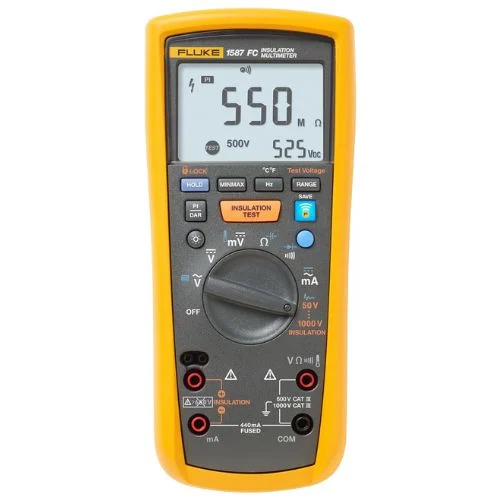
Finding and fixing problems quickly is essential to job safety and effectiveness. The Fluke 1587 FC Insulation Multimeter provides peace of mind by allowing you to remotely monitor test measurements, with results viewable on your smartphone. With advanced comparison capabilities, finding issues has become easier than ever before.
Taking it a step further, this insulation multimeter also allows you to save and compare measurements over time from the comfort of your wireless device. This intuitive tool will enable workers to manage electrical systems efficiently and provides the speed and accuracy necessary for all industrial techs.
Plus, by using Fluke Connect Assets tools (sold separately), testing can be done even faster! For those who work on motors, generators, cables, or switch gear – the Fluke 1587 FC Insulation Meter could be precisely what you need. With the Fluke 1587 FC 2-in-1 Insulation Multimeter, you can get all your job done quickly and efficiently.
Its ease of use is due to its wireless nature, allowing you to test from a safe distance with its Fluke Connect-enabled technology. It can display readings from up to three-meter modules at once and communicates wirelessly using the mobile app for Android or iOS devices. No matter the job or where you are, the 1587 FC 2-in-1 insulation multimeter allows better testing in a more convenient package.
Specifications:
- Display Counts: 6000
- Auto/Manual ranging: Yes
- AC/DC Voltage measuring range: 1000V
- AC/DC Current measuring range: 400mA
- Resistance: 50.0 MΩ
- Frequency: 99.99 kHz
- Capacitance: 9999 μF
What Works:
- Memory Storage
I found the memory storage feature incredibly useful for tracking multiple readings. It saved me time and minimized errors by storing data directly on the device, allowing easy access later. - VFD Low Pass Filter
This filter worked great for clearing electrical noise and providing accurate readings in environments with interference. It was especially helpful in industrial settings, where noise is common. - Temperature Compensation
The temperature compensation feature worked flawlessly, adjusting measurements based on ambient conditions. This was a real plus when working in environments with fluctuating temperatures, saving me from recalibration. - Troubleshooting Advanced Problems
The advanced diagnostic features helped me identify complex electrical issues quickly. This made troubleshooting much faster, and I was able to pinpoint problems more effectively than with a standard multimeter.
What Doesn’t Work, and Why?
- Missing Probe Tip Cover
The insulation tester probe tip lacks a protective cover, which could lead to wear over time or safety concerns during transport. While it didn’t affect functionality in my trial, it’s something to keep in mind for long-term use.
4. Fluke 115 Digital Multimeter
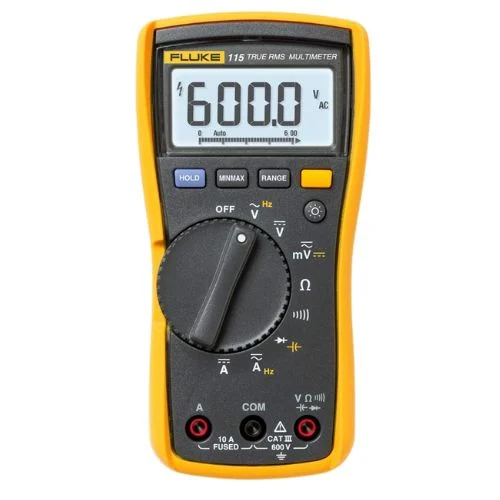
The Fluke 115 Digital Multimeter is a multimeter designed to provide you with accurate readings in any situation. It is safety rated and has a true-RMS system for managing non-linear loads. It also features a large, white LED Backlight that makes working in poorly lit areas easy and efficient.
And it can operate between -10 °C and + 50 °C, plus its storage temperature range extends from -40 °C to +60 °C. With the Fluke 115, you can check continuity, frequency, capacitance, and diode test quickly and accurately like never before. The Fluke 115 Digital Multimeter offers features that make it a great addition to any job site.
With its ability to measure up to 20 A (30 seconds momentary; 10 A continuous) and true-RMS for accurate readings on non-linear loads, the Fluke 115 is well equipped for any task. It is classified with a CAT III 600 V safety rating and has a large white LED backlight that allows you to work in even poorly lit areas. The Fluke 115 is ideal for any job where accuracy and safety are paramount. You can also visit our fluke 117 vs 115 comparisons here.
Specifications:
- Display Counts: 6000
- Auto/Manual ranging: Yes
- AC/DC Voltage measuring range: 600V
- AC/DC Current measuring range: 10A
- Resistance: 40 MΩ
- Frequency: 5 Hz to 50 kHz
- Capacitance: 10,000 μF
What Works?
- Large White LED Backlight: In my trial, the bright backlight was a real highlight. It made the readings crystal clear, even in low-light environments. If you often work in dim spaces, this feature will make your job a lot easier.
- Safety and Reliability: The tool’s built-in safety features were a standout for me. It’s reassuring to know that I’m working with something that reduces electrical hazards. For anyone working on high-voltage systems, this extra layer of protection is a big plus.
- Ease of Use: I found the interface to be incredibly intuitive. I didn’t waste time figuring out complicated settings. Whether you’re a beginner or someone who values simplicity, this tool is easy to get the hang of.
What Doesn’t Work?
- Narrow Usable Field of View: The display’s narrow field of view made it harder for me to see all the readings at once, especially when I was working in tight spaces. If you need to quickly scan multiple readings, this could slow you down.
Why It Matters?
- The LED backlight is perfect for low-light conditions, but the narrow field of view can make it difficult to take in all the info at once. If you’re in cramped spaces, you might want a wider display.
- The safety features are crucial for working on high-voltage systems, and this tool offers a higher level of protection compared to cheaper alternatives.
- Ease of use is a major plus—if you’re a beginner or just want something that works without a steep learning curve, this tool is a great choice.
5.Fluke 117 Digital Multimeter
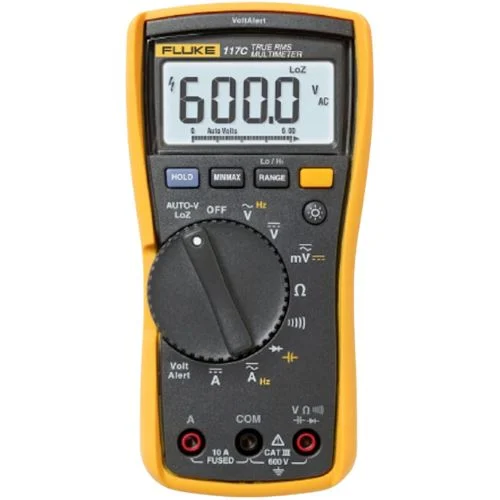
The Fluke 117 Digital Multimeter is ideal for professionals working in commercial buildings, hospitals, and schools. It has an array of features designed to make measurements quick and accurate. Its VoltaAlert technology detects voltage without making contact with whatever is being measured, while its AutoVolt feature automatically selects between ac/dc voltages.
The low impedance (LoZ) feature helps guard against false readings caused by ghost voltage, and a large white LED backlight makes working in poorly lit areas easier. Accuracy can ensure with its True-RMS capability for non-linear loads, plus it measures 10A (with a 20A overload capacity for 30 seconds).
This meter can also perform resistance, continuity, frequency, and capacitance tests. Signal fluctuation can easily track with the addition of Min/Max/Average recording abilities. Additional convenience includes a magnetic hanger (ToolPak) for hands-free operation as well as a CAT III 600V safety rating.
With features like integrated non-contact voltage detection and an optional magnetic hanger for hands-free operation, the Fluke 117 Digital Multimeter is an ideal tool for all preventative maintenance needs. This advanced multimeter also offers improved resolution and accuracy, making it a must-have item for any technician’s toolbox.
Not only does the 117 allow users to conduct tests quickly and accurately, but it also ensures that they are done safely to protect both workers and customers alike. As a result, the 117 is capable of providing dependable performance in just about any working environment. Make sure you have one in your tool belt; it’s sure to come in handy more times than you can count.
Specifications:
- Display Counts: 6000
- Auto/Manual ranging: Yes
- AC/DC Voltage measuring range: 600V
- AC/DC Current measuring range: 10A
- Resistance: 40.00 MΩ
- Frequency: 99.99 Hz
- Capacitance: 1000 nF
What Works:
- True-RMS Accuracy
The True-RMS feature delivered accurate readings even with distorted signals. It was perfect for industrial settings with variable loads, ensuring I didn’t miss any details in complex measurements. - Non-Contact Voltage Detection
This feature was a huge time-saver. I could safely check if circuits were live without direct contact, reducing risks and speeding up my workflow. - Magnetic Hanger
The magnetic hanger was surprisingly useful. It kept the meter in place while I worked, allowing me to focus on other tasks without constantly adjusting the meter.
What Doesn’t:
- Dim Display at Certain Angles
The display became hard to read at certain angles, especially when the meter was hanging or in bright environments. This slowed me down when I needed quick, clear readings.
Why It Matters?
The True-RMS and voltage detection features were game-changers for accuracy and safety. However, the dim display at certain angles is a downside if visibility is important in your environment. If you need a clearer display, consider alternatives with better screen visibility.
Bottom Line
When it comes to finding the best fluke multimeter for electronics, it is essential to consider what features you need and what budget you have. There are many different models on the market, so doing your research ahead of time is a good idea. Once you have decided on the features you need, you can start narrowing down your choices by price. By taking all of these factors into consideration, you should be able to find the best fluke multimeter for electronics for your needs without any problems.
FAQs:
1. What Should I Consider When Choosing a Fluke Multimeter?
Look for features like measurement range, display quality, and durability. Also, consider auto-ranging, backlighting, and price.
2. What’s the Difference Between True-RMS and Average Sensing?
True-RMS provides accurate readings for distorted waveforms, while average-sensing meters may be less reliable with non-sinusoidal signals.
3. How Do I Use the Thermal Imaging Feature on the Fluke-279FC/IFLEX?
Point the multimeter at the component, and it will display temperature data, helping you spot hot spots quickly.
4. Why Is the Fluke 1587 FC Great for Industrial Techs?
It combines insulation testing with advanced diagnostics and remote monitoring, making it ideal for working with motors and switchgear.