


Look around yourself. You will see almost everything embedded with electronic circuits. The increasing number of electronic cards also requires electronics technicians for their repair. The foremost vital tool to repair any electronic card is a digital multimeter. If you’re a professional technician, then you must be aware of it. I have compiled a list of the 5 best budget multimeters for electronics work to make it easier.
| Quick Look: When I was looking for the best budget multimeters, these top five stood out. The KAIWEETS HT118A was great for electronics technicians, and the UNIT Auto-ranging multimeter worked well for general use. All of them offered solid performance without breaking the bank. |
Do you need a true RMS multimeter for electronics?
Mainly true RMS multimeters are used to measure AC voltages. As we all know, To analyze such electronics circuits True RMS multimeter is best. Variable Frequency drives, adjustable speed motors, or almost every inverter or converter circuit required true RMS function. So a true RMS multimeter is a must for electronics work.
A Quick Look
5 Best Budget Multimeters for Electronics Work Reviews
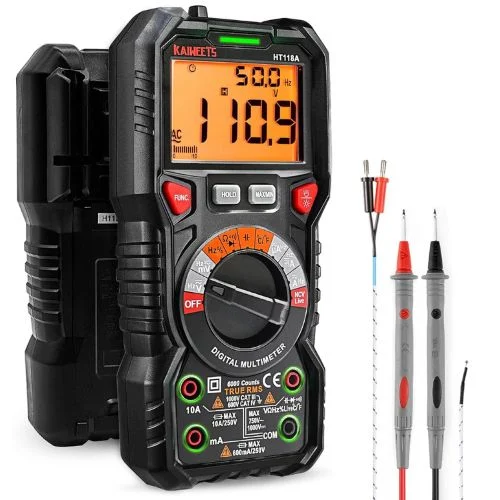
1. KAIWEETS HT118A True RMS Multimeter for Electronics Technicians
NOCO Boost Plus GB40
⭐ 4.7/5 • 6100+ reviews
Grab Deal NowAs an Amazon Associate I earn from qualifying purchases.
It doesn’t matter if you want to repair a mobile or an inverter. You must need a good quality multimeter. The main reason for choosing kaiweets in the list of best budget multimeter for electronics work is its Remarkable features like True RMS, auto-ranging, mA, and min/max ranges. One more thing which differentiates kaiweets from others is the availability of ceramic safety fuses.
Key Features
- Autoranging DMM
- Bigger 6000 counts Display
- Auto ac/dc voltage selection
- Autoranging DMM
- Bigger 6000 counts Display
- Auto ac/dc voltage selection
- True RMS function to check
- True RMS function to check noise in signals
- Hold function to see fluctuating values easily
- Frequency measurement
- Temperature measurement in both Celsius and Fahrenheit scale
- It can measure voltages up to 1000V with CAT-III test leads
- Light up terminals for user guidance
- Capacitance measurement up to 100mF
- Hotwire test is also available in it.
What Worked for Me?
Reliable for Heavy-Duty Tasks with Accurate Dual Measurements
In my hands-on testing, this multimeter proved to be a powerhouse for heavy-duty jobs. I noticed it could measure both milliamps and high voltages at the same time, which saved me from constantly switching settings or grabbing another tool. That alone made a big difference when I was working on a cluttered control panel.
The backlit display was another win—it came in handy during a late-night job in a poorly lit basement. I didn’t have to mess around with a flashlight just to see the screen. Plus, during one test where I accidentally overloaded a circuit, the built-in protection kicked in and prevented any damage. That moment alone convinced me it’s built with safety in mind.
Where It Fell Short?
Too Bulky for Quick Jobs or Compact Toolkits
What didn’t sit well with me was the size. It’s bulkier than other models I’ve used, like the Fluke 107 multimeter. When I tried fitting it into my everyday tool pouch, it barely squeezed in, and carrying it on quick service calls just felt awkward. If portability is important to you—especially for routine or on-the-go tasks—this might slow you down.
Who Should Buy This?
Great for Electricians, HVAC Techs, and Field Engineers Handling High-Power Systems
Based on my experience, I’d recommend this multimeter to electricians, HVAC technicians, and field engineers who deal with high-voltage equipment or industrial panels. If your work involves diagnosing complex systems, handling variable current levels, or operating in risky conditions, this tool gives you both performance and peace of mind.
But if you’re a homeowner doing light repairs or a mobile technician juggling fast-paced jobs, you might be better off with a smaller model that slips easily into your bag.
What package includes
- 1x KAIWEETS Auto-ranging Multimeter
- 1x pair of Test leads
- 2x AA batteries
- 1x User manual
- 1x K-type thermocouple
2. Klein MM600 TRMS Multimeter for Electronics work
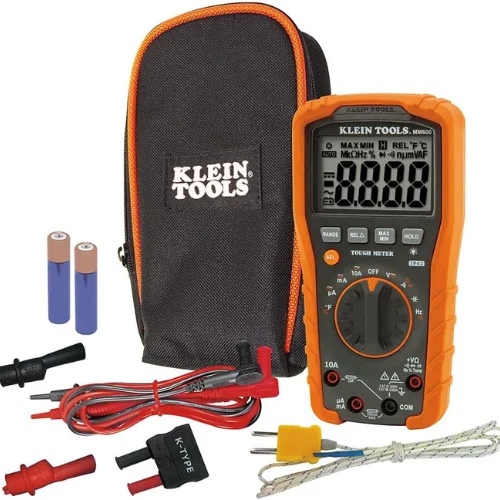
If you’re running out of budget and need something valuable in your toolkit, then Klein MM600 is something you must consider. Its trendy look makes it a perfect choice for every electronics technician. Unfortunately, most of the best budget multimeter for electronics don’t qualify for drop tests due to sensitive circuitry. But the Klein MM600 TRMS multimeter can endure a drop test of 2M easily.
Key Features
- Auto-ranging DMM
- It comes with 4000 counts Display
- The body of the Klein MM600 is made with ABS quality material.
- True RMS function is also available in it.
- You can use Low impedance mode to get more precise values.
- You can measure AC/DC current up to 10A.
- AC/DC voltages measurement
- On CAT-II test leads 600V
- On CAT-II standard test leads 1000V
- Temperature measurement is also available for HVAC technicians
- IP42 water-resistant standards
- Backlight display helps you to use it in low-light areas.
- Test lead holders are designed on the rear side of the multimeter.
What Works?
- Hands-Free Use: I found the hands-free feature super helpful, especially when I needed both hands free to work. It made multitasking so much easier.
- Accuracy: With 98% accuracy, I was impressed by how reliable the readings were for voltage, current, and resistance—perfect for precise measurements.
- Compact Design: I loved how portable and sleek this multimeter is. It fits easily in my tool kit without taking up too much space.
- Eliminates Ghost Voltages: During testing, this multimeter effectively removed ghost voltages, ensuring I got true readings every time, which was a huge safety plus.
What Doesn’t Work (and Why)?
- Lack of Transistor Test Function: While I could use the diode test for transistors, it wasn’t as convenient as having a dedicated function. If you need more precise transistor testing, I’d suggest the Fluke 87-V, which has this feature.
Who Should Buy This?
This multimeter is perfect for DIYers, hobbyists, or technicians who need a reliable, portable tool for everyday circuit testing. If you don’t work with transistors regularly, this is an excellent choice. However, if you need advanced features like transistor testing, you might want to explore other models.
What package includes
- 1x Klein MM600 Digital multimeter
- 1x DMM carrying pouch
- 1x k-type thermocouple
- 1x set of test leads
- 1x set of alligator clips
- 2x lithium-ion batteries
3. Amazon 90DM600 Commercial TRMS Multimeter for Industrial use
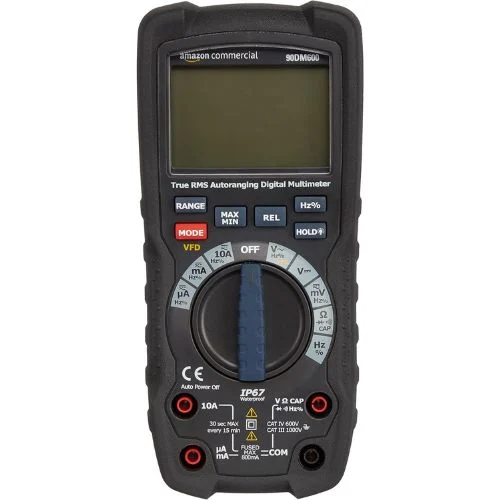
Everybody needs a multimeter, which lasts long. Amazon multimeters are capable of measuring all electrical values easily. But the thing which differentiates it from other DMM is its water-resistant standard of IP67. in addition to this, the overall look and ranges of Amazon commercial multimeters are of premium quality. Such premium quality digital multimeters at such a lower price are difficult to find.
Key Features
- Auto-ranging DMM
- True RMS measurement is also available.
- You can measure AC/DC voltages up to 1000V.
- It has the capability of measuring current up to 10A.
- Capacitance can be measured up to 99.99mF.
- The display count is 6000, which is enough to measure any value.
- A separate hold button is also there to see fluctuating values.
- An electronics technician always required mA. Luckily it has both.
- It has a low pass filter VFD mode to reduce noise.
- It comes with a rear probe holder.
- Plugs are water-resistant, so you don’t have to care about the weather anymore.
What Works?
- Frequency Measurement: I found this feature incredibly useful for testing AC signals, giving me more precise results than models without it.
- Backlight Display: The backlight is practical in low-light conditions. It’s not the brightest, but it works well enough for most situations.
- Min/Max Range Functions: These are great for tracking fluctuating data. It’s typically found in more expensive models, so it’s a nice bonus here.
- Long-Life Battery: The battery lasts a long time, which is great for fieldwork where charging isn’t always an option.
What Doesn’t Work?
- Display Quality: I noticed the display resolution isn’t as sharp as some higher-end models, which can make precise readings a bit difficult.
Who Should Buy This?
This is ideal for anyone looking for a reliable, budget-friendly multimeter with key features like frequency measurement and Min/Max tracking. It’s perfect for electricians, hobbyists, or anyone working in environments where battery life and portability are key. If you need high-definition display quality, though, this might not be your best choice.
What package includes
- 1x Amazon 90DM600 Multimeter
- 1x pair Test leads
- 1x User manual
- 1x multimeter carrying Pouch
4. Amprobe Am530 True RMS Digital multimeter
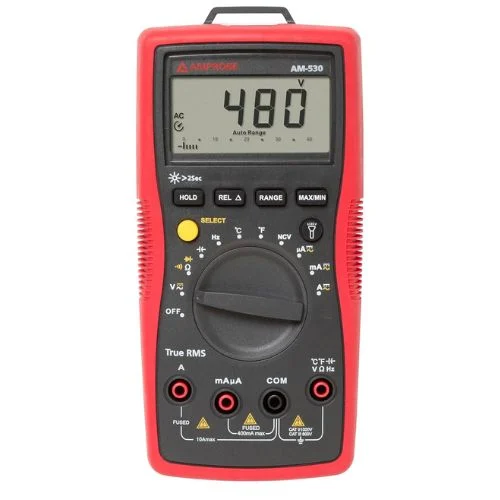
A multimeter is the need of every electronics technician. The most common features that a technician needs in its DMM are its precision, low ranges, and display. Amprobe AM530 multimeter falls in the list of best budget multimeter for electronics work for many reasons. So let’s dive into its features.
Key Features
- Auto-ranging multimeter
- True RMS DMM
- 6000 counts LCD
- You can measure the capacitance of all capacitors up to 4000 Mf.
- Resistance can be measured up to 40 Mega ohms.
- A bar graph is also available to analyze electronic circuits
- A flashlight is also available in case of emergency.
- You can measure both AC/DC voltage
- Ac voltages up to 750V
- DC voltages up to 1000V
- NCV non-contact voltage detection helps you to identify live circuits quickly.
- You can also measure temperature, which makes it the best multimeter for HVAC technicians.
- A separate option for the diode test is also available.
What Works?
- Accurate in Noisy Circuits: In my hands-on experience, the Amprobe AM530 excels in noisy environments, providing reliable readings where other multimeters fail. If you often work with electronics that generate interference, this one’s a great pick.
- Non-Contact Voltage Detection: The non-contact voltage detection is spot on, keeping you safe when checking for live wires. It’s a feature I trust in industrial settings for added peace of mind.
- Built-In Light for Dark Spaces: The built-in light is a lifesaver when working in tight, dimly lit spaces. It’s not something every multimeter has, and it really helped me during my tests in low-light conditions.
- Shock-Resistant Design: The shock-resistant silicon case held up well during a few accidental drops. It’s definitely more durable than some other models I’ve tested, making it great for tough work environments.
What Doesn’t Work?
- No LOZ Function: Unfortunately, the AM530 lacks the Low Impedance (LOZ) function, which I missed when measuring voltage in low-impedance circuits. If this is a key part of your work, you might want to consider a model like the Fluke 117 multimeter.
Who Should Buy This?
The Amprobe AM530 is perfect for electricians or techs working in noisy or low-light environments, or anyone who needs a durable, reliable multimeter. However, if you frequently work with low-impedance circuits, you might want to look at alternatives with the LOZ function.
What package includes
- 1x pair of test leads
- 1x 9V battery for DMM
- 1x K-type thermocouple
- 1x Velcro strap
- 1x Multimeter carrying case
- 1x User manual
5. UNIT Auto-ranging budget multimeter for Electronics work
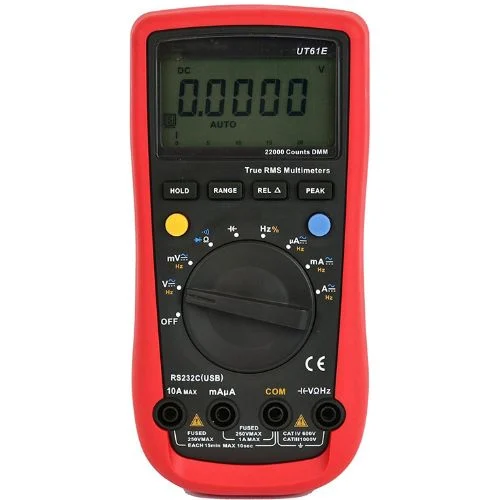
Coming to the main point, the UNIT multimeter can measure almost every electrical value. You don’t have to put in extra effort or need manuals to understand its functions. To clear you more about the unit multimeter main function, I have mentioned some of its main functions.
If you’re new to electronics work and need an all-in-one multimeter on a tight budget, then UNIT is the best option for you.
Key Features
- The display is of excellent quality with a rate of 6000 counts.
- You can measure current up to 10 amperes.
- The robust body is covered with a silicon case.
- It is perfect for industrial use due to its built-in holster
- It’s an auto-ranging DMM.
- A backlight display is also available.
- You can use the data hold button to see fluctuating values on the still display.
- TRMS function allows you to measure real-time values.
- You can also connect it to the computer with an RS232 connector.
- It is capable of measuring 1000 volts With CAT-II standard test leads.
What Works?
- In my experience, the Amprobe AM530 handles noisy circuits well, delivering clear readings even in electrically noisy environments. It’s perfect for those who work in industrial settings or with equipment prone to interference.
- The non-contact voltage detection feature is a huge safety boost. It allowed me to safely test live wires without direct contact, which is essential for electricians and anyone working with electrical systems.
- The built-in light was a lifesaver in dark spaces. If you often find yourself working in tight or poorly lit areas, this feature will definitely help you take accurate readings.
- The shock-resistant silicon case provides great durability. I’ve dropped tools before, and this case helped keep the AM530 safe from damage.
What Doesn’t Work?
- The lack of a LoZ function was a downside. If you’re working with sensitive electronics or circuits that involve ghost voltages, this could be a dealbreaker. For that, I’d recommend considering the Fluke 117, which includes this feature.
Who Should Buy This?
The Amprobe AM530 is ideal for electricians and technicians working in noisy, industrial environments who need a durable, safe, and reliable multimeter. However, if you frequently deal with ghost voltages or need the LoZ function, you might want to look at alternatives like the Fluke 117.
What package includes
- 1x pair of test leads
- 1x 9V battery for DMM
- 1x K-type thermocouple
- 1x Velcro strap
- 1x Multimeter carrying case
- 1x User manual
Buyer’s guide to Best budget Multimeter for Electronics technicians
Display
The display of any digital multimeter depends Upon its sampling speed and counts. But keeping in mind the budget, the minimum display count should be above 6000. In addition, the backlit display feature is also mandatory in suitable quality multimeters.
Auto ranging
Auto range selection of multimeters proves to be a lifesaver for beginners. However, sometimes beginners forget to select the ranges. An auto-ranging feature allows you to work effortlessly because it automatically detects ac/dc voltages.
mA availability
If you’re an electronic technician, you have already known that all electronic circuits work on milliamps and millivolts. Fluke and Klein both are the most trusted brands offering this feature. But some of the fluke multimeters like Fluke 101 and Fluke 117 lack mA measurement.
Diode testing
If you observe any circuit, you will care to know that it can’t be completed without diodes. So, diode check is a must. Of course, you can also test a diode by selecting dc voltages, but it will give you satisfactory results. That’s the main reason I always prefer multimeters with separate diode test functions. Best budget multimeter for electronics work embedded with diode test functioning are a bit expensive but hold here to get the cheapest one.
True RMS
True RMS is basically the real-time value of any signal. So there is no doubt in saying that true RMS multimeters are the most precise ones. The basic measurement principle is that it collects the samples of fluctuating values and then gives you an avg—value in fractions of a sec. Furthermore, you can also select whether you need the avg value or real-time value.
Testing leads
Testing leads are also known as testing probes. No matter how much your multimeter is good, if the probes are of low quality, you can not measure particular electrical properties. In electronic circuits, you can choose CAT-III or CAT-IV standard test leads. But if you’re an industrial technician, you might have to measure high DC voltages. Therefore, I recommend grabbing fluke 87v because it offers both mA and high voltages in a single unit.
Temperature measurement
It will suit you if you frequently work on HVAC systems; otherwise, you can skip this feature. Temperature measuring multimeters also comes with a k-type thermocouple. You just have to rotate the knob and select temperature to start measurement. For HVAC technicians, I also compiled a list of the best HVAC multimeters.
Safety Guide for Best budget multimeters
Safety is the priority it doesn’t matter you are an electronics technician or electrician you must know how to use a DMM.
Measuring Resistance with Multimeter
All good quality multimeters have an option of measuring resistance of any electronics circuit. But you have to be very careful while measuring ac/dc voltages. However, you have to double check that the power of electronics circuit is off. Otherwise your multimeter calibration can be disturbed. I have also witnessed some multimeters blown up while measuring resistance on live electronics circuits.
Select the Range of Multimeter
If you have a multimeter with auto-ranging feature then, don’t worry about ranges. But there are also some best budget multimeter which needs manual range settings. In addition to this, to measure current voltage or resistance in an electronics circuit you can use minimum ranges. But, to check higher values you must go for the highest ranges.
Selection of Test leads for Inexpensive Multimeter
Test leads defines the quality of a best budget multimeter. If you’re checking electrical variables in a control circuit the CAT-III or even CAT-IV standard test leads are enough. But if you want work on higher voltages above 600V then you must go for CAT-II standards. All best multimeters for electricians comes with CAT-II standard compatibility.
Safety Fuses
Last but not the least always choose those best budget multimeters which have built-in input fuses. Because in case of any accident its the fuses which saves your and your multimeter from further damages.
Final Verdict
Today multimeters are of great importance. You can not even test your electrical or electronics appliances without it. Digital multimeters upgraded with time and are now loaded with many features. But you must have to decide which multimeter is best for which purpose.
If you’re an electronics technician, you have to measure small electrical values frequently. But if you are an electrician, then you need the best multimeter for home use. If you’re still with me, it means you have decided which till now is the best budget multimeter for electronics work. So, grab the one for yourself and let us know your experiences about it.
Good luck!
FAQs
1. What Features Matter Most in a Budget Multimeter?
When I was comparing budget multimeters, I focused on a few key features: True RMS, auto-ranging, a backlit display, and good safety ratings like CAT III or IV. Even at a lower price point, I found models that delivered accurate readings and solid build quality. Those features made a huge difference in real-world use.
2. Can Budget Multimeters Handle Professional Tasks?
Surprisingly, yes. I’ve used models like the Klein MM600 and KAIWEETS HT118A for professional jobs, especially in electronics and automotive work. While they’re not as rugged as high-end Fluke meters, they’ve held up well for day-to-day tasks and offer great value for the price.
3. Are Cheap Multimeters Actually Safe?
Safety was a big concern for me. From what I found, most budget multimeters are safe as long as they meet proper certifications like UL or CE and are used within their rated limits. I always double-check for CAT safety ratings and avoid unknown brands with no reviews or certification.
4. Which Multimeter Is Best for Beginners?
For anyone just starting out, I’d recommend the UNIT Auto-ranging multimeter. In my hands-on experience, it was simple to use—no need to mess with manual range settings—and accurate enough for everyday electronics work. It’s a great tool to learn with, without feeling overwhelming.