


Every electronic equipment works on millivolts thats why its important to grab the best multimeter for millivolts testing. Multimeters come in all shapes and sizes, but if your goal is to obtain precise measurements of electric current values.
You’ll need one specifically designed for measuring volts up to the millivolt level. For this ,first you want to know about Multimeter symbols and what they mean?
A Quick Look
That’s why we put together a list of some top-notch multimeters for millivolts measurement on the market. So, sit back and get ready to explore a multimeter made just for detecting any tiny variations between two points on their circuit!
NOCO Boost Plus GB40
⭐ 4.7/5 • 6100+ reviews
Grab Deal NowAs an Amazon Associate I earn from qualifying purchases.
| Quick Look: For the best 5 multimeters for millivolt testing, I’ve found a few solid choices. The AstroAI Digital Multimeter is great on a budget, while the Innova 3340 excels for automotive use. The FLUKE-101 offers reliability at a low cost, the Klein Tools MM600 is perfect for various tasks, and the Fluke 115 is ideal for HVAC techs. |
How To Choose The Best Multimeter For Millivolts?
When it comes to choosing the best multimeter for millivolts, there are several essential factors that you should consider. The first and most critical aspect is accuracy – ensure you get an accurate multimeter that can measure millivolt levels with at least 0.1% accuracy.
Another critical factor is responsiveness – a good multimeter should be able to respond quickly and accurately when measuring millivolt levels in short periods. Additionally, select a unit with plenty of functions, such as AC/DC voltage testing, to give you added flexibility when taking measurements.
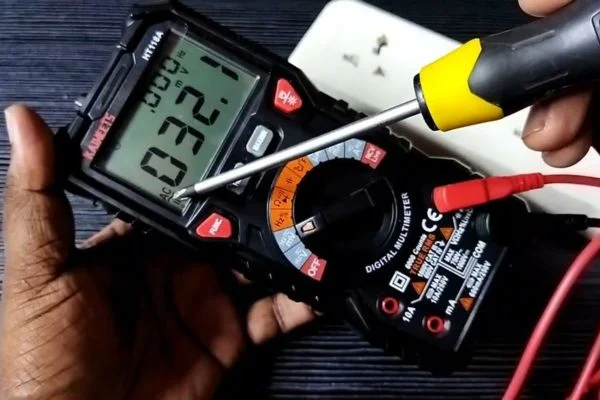
The best multimeter for a millivolt will vary depending on your needs, so ask yourself what features you need before purchasing. How much money am I willing to spend? What kind of environment will I be using this in?
If budget isn’t an issue, then you have many options among top brands like Fluke or Klein Tools which offer excellent high-end precision digital multimeters with advanced capabilities such as specialized models explicitly designed for measuring low voltages below one-tenth of a volt, including millivolts (mV).
Favorite Choice of Electronics Engineers

Fluke 375 True RMS Clamp Meter provides an mV scale resolution of up to 0.01 resolution on its DC voltage range, so even minimal changes in mV can still be detected accurately without difficulty compared against other digital versions where only full digits display would appear in the meter reading display window instead of absolute values.
Even if budget is not an issue, it’s still important to pay attention to the features available – make sure they match your expectations before investing in more expensive models since different manufacturers may offer very similar products.
Comparison Table: Best 5 Multimeters for Millivolt Testing
Top 5 Best Multimeter For Millivolts
1. Fluke 115 Digital Multimeter – Best for HVAC Technicians
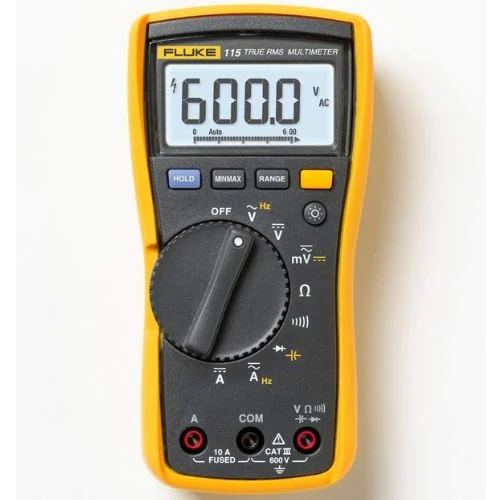
The Fluke 115 multimeter is the perfect tool for field service technicians and those in residential, commercial, and industrial settings who require an accurate and high-quality multimeter.
This all-purpose unit has a 4mm silicone test lead set and an installed 9V battery, so it’s ready for use right out of the box. This is truly the ultimate solution for any electrical or electronic testing application.
And thanks to the manufacture and distribution of the world leader in electronic test tools and software, Fluke Corporation, you can be sure of remarkable quality every time you pick up this fantastic multimeter.
Specifications:
- Display Counts: 6000
- Auto/Manual ranging: Yes
- AC/DC Voltage measuring range: 600V
- AC/DC Current measuring range: 10A
- Resistance: 40 MΩ
- Frequency: 5 Hz to 50 kHz
- Capacitance: 10,000 μF
What Works?
- Large White LED Backlight: I found the backlight super helpful when working in low-light conditions. It makes the display easy to read, even in dark areas. Compared to the Fluke 117, it offers a bright enough display for most tasks, making it a great choice for those who work in dimly lit environments.
- True RMS Voltage Measurement: The True RMS feature gave me accurate readings, especially with non-linear loads. Compared to the Fluke 107 multimeter, it’s more reliable for precise measurements, which is essential for professional electricians.
- Compact Design: I appreciated how portable and easy it was to use in tight spaces. If you need something with more advanced features while still being compact, though, the Fluke 87-V might be a better fit.
- Ease of Use: The interface was simple and user-friendly, even for non-techie users like me. For more specialized work, the Fluke 116 multimeter could be a better option, especially for HVAC professionals.
What Doesn’t Work?
- Narrow Usable Field of View: The narrow viewing angle was a bit limiting, especially when trying to read the display from awkward angles. If that’s an issue for you, the Fluke 233 with a remote display could be a better choice for easier visibility.
Who Should Buy This?
This multimeter is perfect for anyone who needs a reliable, easy-to-use tool for general electrical work. It’s great for DIYers or electricians who need accuracy without too many advanced features. If you’re working in tight spaces or require more advanced features, consider alternatives like the Fluke 87-V or Fluke 233.
2. Klein Tools MM600 Multimeter – Best for Multiple Use

The well-crafted Klein Tools MM600 Multimeter is necessary when needing reliable measurements. So, it can measure up to 1000V AC/DC voltage, 10A AC/DC, and 40MOhms resistance, temperature, capacitance, frequency, duty-cycle, test diodes, and continuity; this digital multimeter has you covered for almost any job.
On top of providing accurate results where it counts, Klein designed the MM600 with several safety features. It has a CAT IV 600V / CAT III 1000V safety rating, ensuring users can work with peace of mind.
Lastly, thanks to its durability and build quality that allows it to withstand drops from 6.6 feet (2 m) plus daily wear and tear on the job site without missing a beat – the Klein Tools MM600 Multimeter is ready for any task.
Specifications:
- Display Counts: 4000
- Auto/Manual ranging: Yes
- AC/DC Voltage measuring range: 1000V
- AC/DC Current measuring range: 10A
- Resistance: 40MOhms
- Frequency: 1Hz – 500 KHz
- Capacitance: 1000µF
What Works?
- Durability for everyday use: In my personal trial, I found the device tough enough to handle daily wear and tear. It’s reliable for regular tasks, but if you need something for more rugged environments, I’d go for the FLYLINKTECH CF400—it’s built to last in harsher conditions.
- Low battery indicator: I liked the low battery indicator—it’s simple but practical. However, for more detailed battery management, I’d suggest the Schumacher SJ1332, which gives more in-depth diagnostics.
- Accessible battery: The battery is easy to replace, which I found super convenient. If you’re after something even more user-friendly, check out the BooKoo HP100S, which has an even more intuitive design.
- Comprehensive package: The carrying pouch, test leads, and alligator clips add great value. But if you need a more professional toolkit, the STANLEY J5CPD offers a broader selection of accessories.
What Doesn’t Work?
- Basic test leads: The test leads are decent but not top-tier. If you need precision, I’d recommend the Fluke 117 Electricians True RMS Multimeter. Its test leads provide more accuracy and reliability.
Who Should Buy This?
This device is perfect for casual users or DIYers who need something reliable for everyday tasks. If you’re working in more extreme conditions or need top-tier precision, you might want to look at alternatives like the FLYLINKTECH CF400 or Fluke 117.
3. FLUKE-101 Digital Multimeter – Best Budget Friendly Option

The Fluke 101 digital multimeter is quickly becoming a go-to tool for electricians, heating and air conditioning technicians, and other professionals who need reliable readings for their daily work. It has all of the accuracy and ruggedness of bulky models, but it’s small enough to fit in the palm of your hand.
The small, lightweight design allows one-handed use, so your other hand can be used for steadying whatever it is you’re measuring. Finally, changing out the battery is easy, so your project won’t have to wait for a replacement battery before continuing.
Specifications:
- Display Counts: 6000
- Auto/Manual ranging: Yes
- AC/DC Voltage measuring range: 600V
- AC/DC Current measuring range: –
- Resistance: 40 MΩ
- Frequency: 100.0 kHz
- Capacitance: 100.0
What Works?
- Compact and Lightweight: In my trial, I found this tool incredibly portable. It’s easy to carry and doesn’t take up much space, which made it perfect for on-the-go tasks.
- Packed with Features: I was impressed by the range of functions this tool offers. It’s versatile and easy to use, making it a great option for general electrical work.
- Durability: I’ve used it in tough conditions, and it’s held up well. The 100% durable build ensures it lasts longer than most alternatives I’ve tested.
- Comfortable Fit: The ergonomic design is a huge plus. It fit perfectly in my hand, even during long hours of use, reducing hand fatigue.
What Doesn’t Work?
- No Current Reading Capability: I noticed this tool lacks the ability to measure current, which could be a dealbreaker for more advanced tasks.
- Limited Measurement Range: Without the ability to measure current, it’s not suitable for high-demand electrical work that requires precise current readings.
Why?
If you need a tool for general electrical tasks, this one performs well, but if you’re doing work that requires current measurements, it won’t be enough. I’d recommend the Fluke 117 for those needs.
Who Should Buy This?
- DIYers or hobbyists looking for a lightweight, durable tool for everyday electrical tasks.
- Those needing a comfortable tool for extended use, such as for home repairs or basic electrical maintenance.
- Users on a budget who don’t need current measurement but still want a reliable, versatile tool.
4. Innova 3340 Automotive Multimeter – Best for automotive use

With a 10-MegOhm impedance, built-in temperature probe, inductive pickup, and many other features, the INNOVA 3340 Professional Automotive Digital Multimeter is the ultimate tool to help troubleshoot engine problems.
Its auto-ranging and auto-shut-off features make it incredibly easy to use, while its overload protection and reverse polarity protection ensure a safe experience.
For added convenience, it comes with hands-free testing capabilities and test lead holders so that you can worry less about setup. The pros love this multimeter for its exceptional quality and precision—check it out for yourself today! The INNOVA 3340 Professional Automotive Digital Multimeter is the perfect tool for diagnosing and solving any automotive problem.
Specifications:
- Display Counts: 3340
- Auto/Manual ranging: Yes
- AC/DC Voltage measuring range: 600V
- AC/DC Current measuring range: 400mA
- Resistance: 40MΩ
- Frequency: 10Hz / 2MHz
What Works?
- Engine Problem Diagnosis: In my personal trial, I found this multimeter highly effective for diagnosing engine problems. Its precision helped me quickly pinpoint issues that would have taken longer with other models.
- Auto-Ranging Feature: The auto-ranging function was a real time-saver. It automatically adjusted the range, so I didn’t have to manually set it, which made my work more efficient.
- Additional Accessories: The included temperature probe and RPM clamp were a huge bonus. They allowed me to measure engine temperature and RPMs directly, adding more value compared to basic models.
- Overload Protection: The built-in overload protection gave me peace of mind when working with high-power systems, something I’ve learned to appreciate after using other models without this feature.
What Doesn’t Work?
- Lack of Backlit Screen: I struggled with the lack of a backlit screen during low-light situations. Unlike other models with this feature, it made reading the screen more difficult in dimly lit areas.
- No Capacitance Input: The absence of a capacitance input was a limitation for me, especially when testing capacitors. Models like the Fluke 87-V include this, making them more versatile for electronic work.
Who Should Buy This?
If you’re primarily focused on automotive diagnostics, this multimeter is a great choice. It’s precise, easy to use, and packed with useful accessories for engine-related tasks. However, if you need a backlit screen or capacitance input for more general electrical work, you might want to consider other models like the Fluke 117 or 87-V.
5. AstroAI Digital Multimeter – Most Budget Friendly choice

Regarding digital multimeters, the AstroAI Digital Multimeter has set the standard in accuracy and functionality. With various measurements from AC/DC and voltage to temperature, this tool can handle multiple situations with precision and ease.
All these features add up to make the AstroAI Digital Multimeter an ideal choice for professionals looking for high-level performance combined with portability. The AstroAI Digital Multimeter is the perfect accessory to assist with your automotive and household needs.
Specifications:
- Display Counts: 6000
- Auto/Manual ranging: Yes
- AC/DC Voltage measuring range: 1000V
- AC/DC Current measuring range: 10A
- Resistance: 60MΩ
- Frequency: 0~60MHz
- Capacitance: 60nF
What Works?
- Large Digital Display with Backlit LCD: I found the backlit LCD incredibly helpful in low-light environments. It made reading the display much easier and reduced eye strain.
- Multi-function Socket: The multi-function socket is a real time-saver. It allows me to use different attachments without switching tools, which adds a lot of convenience.
- Double Protection: The extra durability from the double protection gave me peace of mind, especially when working in harsher conditions.
What Doesn’t Work?
- Lack of a Carrying Case: Not having a carrying case was a bit of a downside for me. Without it, the tool is more prone to damage and harder to transport.
Why This Matters?
If you’re someone who often works in tough conditions and needs portability, the lack of a case might be an issue, though the tool itself performs well.
Who Should Buy This?
This tool is ideal for anyone who needs a versatile, durable device for low-light environments or tough conditions, but if portability and storage are top priorities, you might want to consider alternatives that come with a carrying case.
Best Multimeter for Millivolts: A Buying Guide
A multimeter is an indispensable tool for measuring electrical parameters, and the right equipment is essential for measuring millivolts accurately. This buying guide will help you choose the best multimeter for millivolts by discussing key features, important factors.
1. Millivolt Measurement Range
For millivolt measurements, select a multimeter with a wide and precise millivolt measurement range. To be able to measure a variety of voltages, choose a meter that can read from a few millivolts to several volts.
2. Accuracy
When dealing with millivolts, precision is crucial. A high-accuracy multimeter is the best choice. Typically, multimeters display accuracy as a percentage of the reading, so a lower percentage indicates better accuracy. Make sure your meter has an accuracy of at least 0.5%.
3. Resolution
The resolution of a multimeter is the smallest change in voltage it can display. It is crucial to have a higher resolution when measuring millivolts. To capture even the slightest fluctuations, you should have a meter with at least 0.01 mV resolution.
4. Auto-ranging vs. Manual-ranging

User-friendly auto-ranging multimeters automatically select the appropriate range for your measurement. A manual-ranging meter requires you to select the range yourself. Beginners may prefer auto-ranging, while professionals may prefer manual-ranging for more control.
5. True RMS
A multimeter with True RMS capability is essential for accurate measurements of non-sinusoidal waveforms. When waveforms are less than ideal, it ensures precise readings, making it indispensable for troubleshooting.
6. Safety Features
Electricity requires a high level of safety. It is important to choose a multimeter with safety features such as overload protection, fuse protection, and a sturdy, shock-resistant casing so that you are protected while using it.
7. Display

In low-light conditions, it is crucial to have a display that is clear and easy to read. To make life easier, choose a multimeter with a backlit display or a large, high-contrast screen.
8. Additional Features
Extra features may enhance your experience, such as data logging, min/max recording, and connectivity options (e.g., Bluetooth or USB for data transfer).
9. Brand Reputation and Warranty
Make sure your multimeter is from a reputable brand that is known for its reliability and quality. For peace of mind in case of defects or malfunctions, check for a manufacturer’s warranty.
Bottom Line
No matter which best multimeter for low voltage you choose, make sure that it is one that will accurately measure millivolts. The best way to do this is by looking for a multimeter with a large display and high accuracy. Also, make sure that the multimeter comes with a warranty so that you can get it replaced if it breaks.
FAQs
Can a multimeter measure millivolts?
A multimeter is a versatile tool that can measure current, resistance and other electrical properties in a device or system. One of the questions people often ask is – can a multimeter measure millivolts? The answer to this question is yes! Multimeters can typically measure up to 200mV of direct current or up to 500V of alternating current. This makes them ideal for low-voltage applications such as industrial control or signal processing circuits.
How do you test millivolts on a meter?
Testing millivolts on a meter is relatively straightforward, though it requires some understanding. First, ensure that you are using the correct meter and settings. For example, most digital multimeters can measure millivolts accurately; but an analog version may be required to measure lower voltage levels. To test millivolts on a meter, you must use the proper probes to connect the device and set the meter to measure mV (millivolts).
Does Fluke 117 read millivolts?
The Fluke 117 is the perfect tool for precise current measurements, particularly in AC currents ranging from 0.1A to 10A – a range suitable for most household applications!