
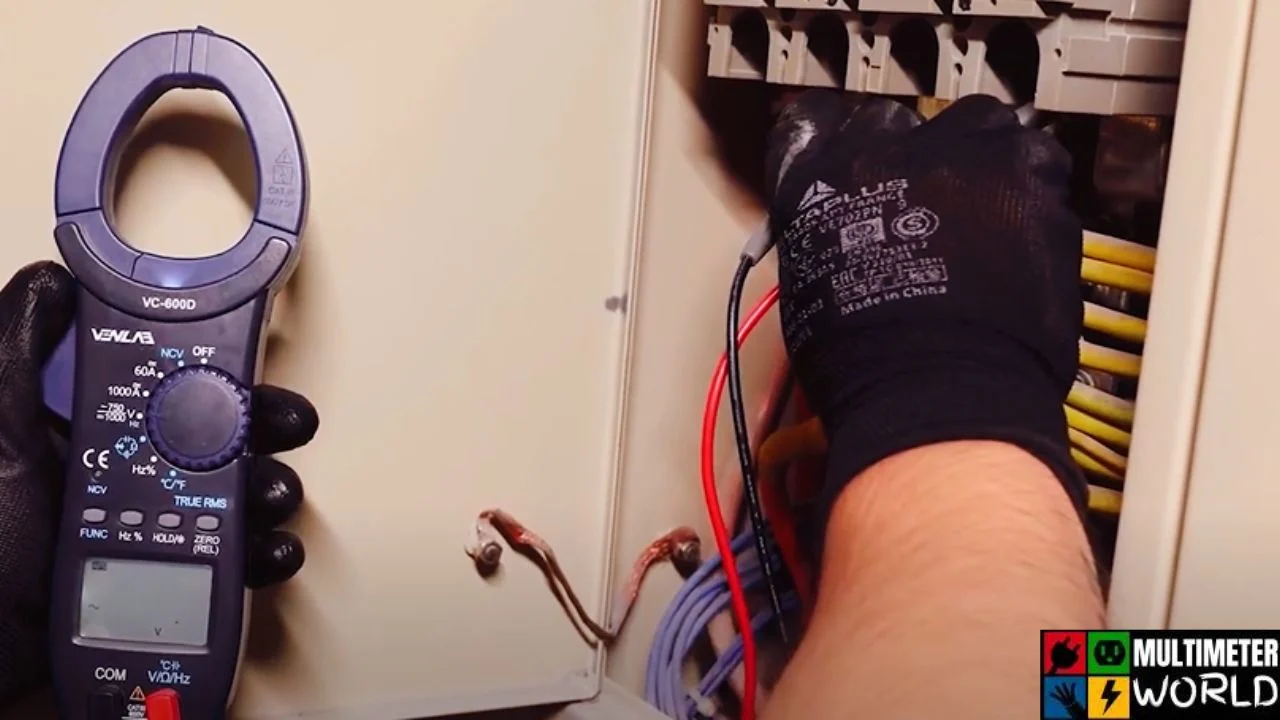

A clamp meter is an essential tool for HVAC professionals. Best Clamp Meter for HVAC Work allows you to measure electrical current without having to make contact with the wire. This can be very helpful when working on live wires. There are many different types of clamp meters on the market. So, which one is the best clamp meter for HVAC professionals?
In this article, I will discuss the 5 best clamp meters for HVAC professionals. Here, I will also provide a buyer’s guide to help you choose the right one for your needs.
A Quick Look
| Quick Look: I’ve tested some of the top clamp meters built specifically for HVAC work, and these tools truly stand out. From the ultra-compact Fluke 362 to the pro-grade Klein CL800, each one has its own unique edge. If you’re tired of unreliable readings and bulky meters, this list is your shortcut to the best picks in 2025. |
Why do HVAC professionals prefer clamp meters over multimeters?
Multimeters are typically used to measure voltage, current, and resistance. However, they cannot be used to measure AC current without turning the circuit off. Because with multimeters you have to attach test leads to the circuit. On the other hand, clamp meters can be used to measure both AC and DC currents with clamp-type jaws. This is why most HVAC professionals prefer clamp meters over multimeters.
NOCO Boost Plus GB40
⭐ 4.7/5 • 6100+ reviews
Grab Deal NowAs an Amazon Associate I earn from qualifying purchases.
Buyer’s Guide to Best HVAC clamp meters
When choosing a clamp meter for HVAC professionals, there are a few things you should consider.
Things you should consider before buying the best clamp meter for HVAC:
1. Accuracy
The accuracy of a clamp meter is very important. You want to make sure that the meter is precise so that you can get an accurate reading. For this purpose, many clamp multimeters come with LoZ mode and True RMS function.
2. Range
The range of a clamp meter is also important. You want to make sure that the meter has a wide range. So that it can measure a variety of electrical variables up to maximum ranges.
3. Safety features
Clamp meters can be dangerous if not used correctly. So, it is important to make sure that the meter has safety features built-in. Such as insulation and overload protection.
4. Size and weight
The size and weight of a clamp meter can be important factors. You want to make sure that the meter is easy to carry around. And that it will fit in your toolbox. Many multimeters have a bigger jaw clamp which is quite difficult to carry.
5. Price
Price is always a consideration when purchasing any tool. You want to make sure that you get the most bang for your buck. In my opinion, if you’re a professional then you can spend a handsome amount. But if you’re a beginner then it’s better to buy multimeters under 100 dollars.
Now that you know what to look for, let’s take a look at the 5 best clamp meters for HVAC professionals.
Comparison Table: Best Clamp Meter For HVAC Work
Best clamp meter for HVAC work – Top 5 Picks
1. Fluke 362 Digital clamp meter for HVAC Work
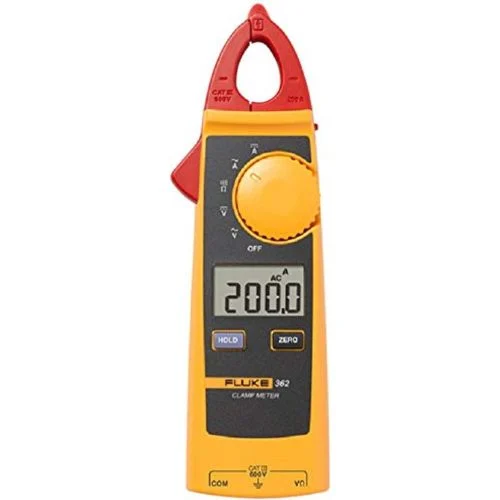
Everyone needs an easy-to-use and precise digital clamp meter. When we talk about Abbott Precision, then fluke will always be at the top. The Fluke 362 clamp meter is a choice for beginners. Whether you have to measure voltages or current then you can do both of them with this electrical tester. The bigger display allows you to see everything easily. Although it’s not the best fluke clamp meter but if you need a budget clamp meter then it should be your priority.
Specifications:
- Current Range: 200A AC/DC
- Voltage Range: 600V AC/DC
- Resistance Range: 3000 Ω
- Safety Rating: CAT III 600V
- Display: Large and easy to read
- Dimensions: 7.87 x 1.57 x 3.94 inches
Features:
- It comes with a zero-error calibration button.
- The bigger LCD display.
- It is capable of measuring current up to 200A.
- You can measure the current of both AC and DC circuits.
- The voltage measurement range is up to 600V for AC/DC circuits.
- You can measure voltage with cat-III rating test leads.
- Unlike other HVAC clamp meters, it can measure dc voltage also.
- A continuity test is also available in it with an audible alarm option.
- Due to its ABS plastic construction, it can easily withstand wear and tear.
What Works, What Doesn’t, and Why?
- What Works: In my experience, the data hold feature is incredibly useful for freezing readings, especially when you need time to jot them down. The meter also delivers accurate readings up to 200A, making it reliable for most standard jobs. I also loved the auto-shutoff function after 15 minutes, which helps save battery. Plus, it’s the most affordable option in the Fluke lineup, providing great value without sacrificing quality.
- What Doesn’t Work: The biggest drawback for me was the lack of capacitance measurement. If you often work with capacitors, this model won’t meet your needs. I found that models like the Fluke 87V or 376 FC would be better suited for those tasks.
Why: This meter is perfect if you need a budget-friendly, reliable tool for measuring current. It’s simple and effective, but if you need to measure capacitance or require more advanced features, a higher-end Fluke model will be a better fit.
Package Includes:
- Fluke 362 Clamp Meter
- User manual
- Test leads
- Soft carrying case
- Batteries
Why Choose Fluke 362 Clamp Meter?
The Fluke 362 offers unmatched precision and ease of use in a compact design, making it perfect for tight spaces and one-handed operation. Ideal for anyone needing a reliable, high-quality meter for both AC and DC measurements.
2. Amprobe AMP-220 HVAC clamp meter- An all in one tool
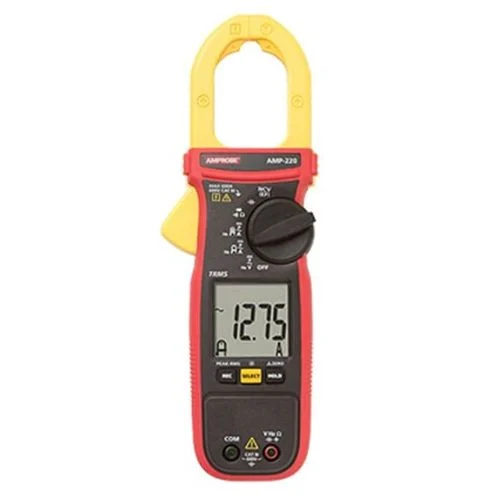
Most people think that clamp meters are expensive in comparison with multimeters. To some extent it is true but there are also many cheaper and more valuable options like Amprobe AMP-220. You can measure almost every electrical variable with this clamp meter like the voltage, current, resistance, and even frequency. Most clamp meters lack these features but Amprobe AMP-220 offers all of these despite its low price.
The thing which makes this meter a decision-making tool is its TRMS function. You can measure electric values without any noise or harmonics. Let’s see some of its features in detail.
Specifications:
- Current Range: 600A AC/DC
- Voltage Range: CAT III 600V, CAT IV 1000V
- Capacitance Measurement: For start and run motor capacitors
- True-RMS Measurement: Ensures accuracy in varying waveforms
- Dimensions: 12.4 x 7.1 x 3.1 inches
- Weight: 0.01 ounces
Features:
- It comes with a bigger square LCD display.
- A backlight is also embedded in it.
- Due to the True RMS function, you will get highly precise values.
- It can measure currents of both AC and DC circuits up to 600A.
- AC/DC voltages can also be measured up to 1000V.
- The Amprobe is manufactured in the United States and for the United States.
- You can measure the frequency of AC and DC signals.
- With non-contact voltage detection, there are no stray voltages and the measurements are accurate.
- In addition to measuring resistance (60kΩ), it can also measure capacitance up to 2500µF.
What Works?
I found the data hold feature incredibly useful for freezing readings, which made reviewing values much easier without losing track. The REC button was also a standout—it allowed me to capture peak values quickly, making it great for fluctuating signals. The larger jaw size made clamping around thicker cables hassle-free, which saved me time on the job. Additionally, the CAT-III test leads gave me peace of mind when working with high-voltage systems, ensuring safety.
What Doesn’t Work?
The major downside I found was the lack of a flashlight. In low-light conditions, it was a bit of a struggle, especially compared to other models like the Fluke 323 that include built-in flashlights. If you’re often in dim environments, this could be a dealbreaker.
In summary, the Amprobe has great features like the data hold and larger jaw size, but if you need a flashlight for low-light work, it might not be the best choice.
Package Includes:
- Amprobe AMP-220 Clamp Meter
- Test leads
- User manual
- Soft carrying case
Why Choose Amprobe AMP-220 Clamp Meter?
The Amprobe AMP-220 combines True-RMS technology and motor capacitor measurement, making it a go-to tool for professionals handling complex electrical systems. Its high safety ratings and durable design make it ideal for industrial and HVAC applications.
3. Klein Tools CL800 Best HVAC Clamp Meter for Professionals
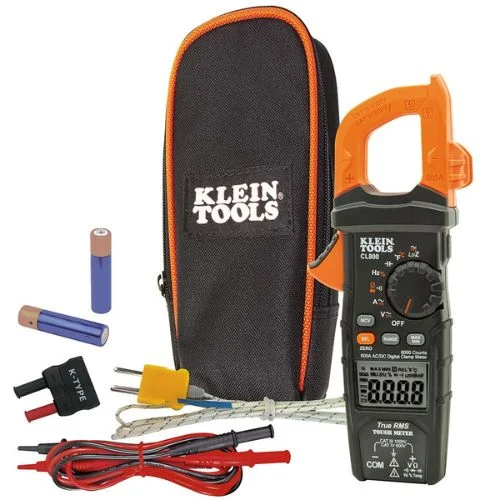
If you want to choose one clamp meter for all electrical, electronics, and HVAC work then Klein CL800 is the best option. It comes with medium current and voltage measurement ranges. Ghost voltages disrupt the measurements significantly in industrial equipment. If you’re looking for hall effect clamp meters then Klein CL900 should be your priority.
An LoZ mode is also installed in it to deal with this issue. Klein Tools also offer the Klein CL900 clamp meter with a bit high range. If you want a detailed comparison of Klein CL800 vs CL900 then I have made a separate blog for this. Let’s see what’s more in this Klein cl800 clamp meter.
Specifications:
- Current Range: 400A AC/DC
- Voltage Range: 1000V AC/DC
- Resistance Range: 60 MΩ
- Capacitance Measurement: 4000 µF
- Display: Backlit LCD
- Weight: 12.5 ounces
Features:
- Like digital multimeters, you can see every electrical value on its 6000 counts LCD display.
- It is an auto-ranging clamp meter so you don’t have to set ranges frequently.
- LoZ mode is installed in it for accurate measurements.
- You can measure current up to 600A in both AC and DC circuits.
- It is a cat-III and cat-iv standard clamp meter, so you can measure voltages up to 1000V.
- An NVC Mode is also available to remove stray voltages.
- Class 2 insulation is perfect for high voltage measurements.
- Klein CL800 is a Drop test certified clamp meter.
- You can also measure temperature with a K-type thermocouple that comes with it.
- It is also capable of measuring capacitance, resistance, and frequency.
- You can measure temperature on both the Fahrenheit and Celsius scales.
- Continuity with alarm and diode test options are also available in it.
- A thermocouple probe also comes with it.
What Works?
- Low Battery Indicator: The low battery warning is super helpful. It gave me plenty of time to recharge, unlike other devices I’ve used that didn’t have this feature.
- Auto Shut-off in Case of Inactivity: I love the auto shut-off. It saves battery, especially since I tend to forget to turn things off.
- 400+ Hours of Battery Life: With over 400 hours of battery life, this model really outperforms others that typically last only 200–300 hours.
- Easy-to-Access Battery Compartment: The battery compartment is easy to reach, making replacements hassle-free, unlike other models that require tools.
What Doesn’t Work?
- Moisture Sensitivity: It’s not waterproof, which can be a problem in damp environments. I’ve used waterproof models that handle moisture better, so this is a key drawback.
Package Includes:
- Klein Tools CL800 Digital Clamp Meter
- Test leads with CAT III/CAT IV safety caps
- Thermocouple
- Carrying case
- 2 x AAA batteries
- User manual
Why Choose Klein Tools CL800 Clamp Meter?
The Klein Tools CL800 offers a versatile and durable solution for professionals needing precise electrical testing in challenging environments. With features like LoZ mode, True-RMS, and built-in worklight, it’s perfect for industrial, residential, or commercial jobs where accuracy and reliability are key.
4. KAIWEETS HT208D True RMS Clamp Meter
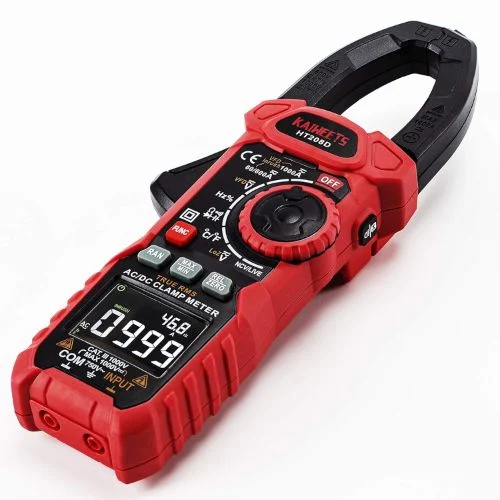
Each professional began as a beginner, so when buying tools, you should be wise. Whether you’re a beginner or an experienced HVAC technician, a clamp meter is the only thing that helps you identify faults. So, keeping in mind budget and advanced functions, I have added KAIWEETS clamp meter to this list of best clamp meter for HVAC technicians. You can measure almost every electrical variable with this all-in-one electrical tester.
Specifications:
- Current Range: 1000A AC/DC
- Voltage Range: 1000V AC/DC
- Resistance Range: 60MΩ
- Capacitance Measurement: 100mF
- Display Count: 6000
- Weight: 700 grams
Features:
- It comes with a 6000 count bigger display.
- A backlight option in the display allows you to see measure values easily.
- As it is a True RMS clamp meter, you don’t have to worry about accuracy.
- You can measure current up to 1000A in both AC and DC.
- Although the voltage measurement depends upon test leads CAT standards.
- You can measure voltages up to 750V with cat-III standard test leads.
- low impedance mode (LoZ) allows you to measure voltages without harmonics.
- An LED flashlight is also installed at the top so your work won’t stop even at night.
- You can also measure temperature in both Celsius and Fahrenheit scales.
- It can also measure inrush current so you can design electrical circuits accordingly.
What Works?
- Duty Cycle Monitoring: I found this feature really useful for tracking performance over time. It saved me a lot of troubleshooting time, especially when working with motor systems and varying loads.
- VFD Testing: This meter handled VFD testing well, giving me more accurate results than typical multimeters. If you regularly test VFDs, it’s definitely a better option.
- Durable Build: The silicone casing and robust body held up great during rough conditions. It’s bulkier than others, but it’s perfect for daily use in tough environments.
- Fast, Accurate Results: I noticed that it provides quick, reliable readings, which really boosted my efficiency when multitasking.
What Doesn’t Work?
- Inrush Current Accuracy Below 10A: The inrush current feature works fine above 10A but loses accuracy below that. If you often deal with lower-current devices, this could be a dealbreaker.
Package Includes:
- KAIWEETS HT208D Clamp Meter
- Test leads
- Carrying case
- Thermocouple
- 2 x AAA batteries
- User manual
Why Choose KAIWEETS HT208D Clamp Meter?
The KAIWEETS HT208D is an excellent choice for those needing a highly accurate and versatile tool for diagnosing inrush current issues, handling high-voltage systems, and ensuring safe and efficient electrical testing across a range of environments.
5. Fluke T5600 Clamp meter for industrial Purposes
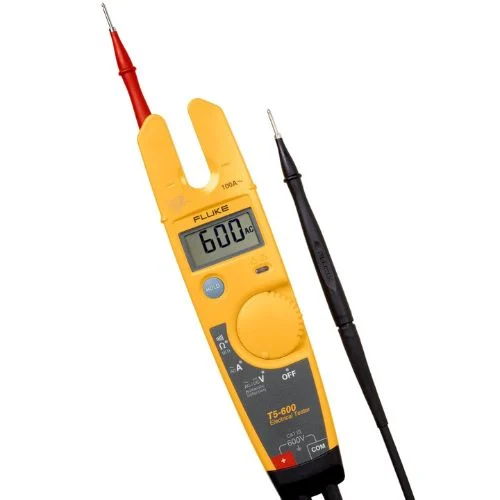
HVAC technicians always need a multimeter that can give precise values in a short time. But clamping wires at confined places makes it difficult. Fluke always comes with innovation, this fluke T5-600 has no clamp-type jaw but only a U-shaped magnetic core. To measure current in a circuit all you have to do is to place the current-carrying conductor in this U-shaped core. Let’s have a deep look into its main features.
Specifications:
- Voltage Range: 600V AC/DC
- Current Range: 100A AC
- Resistance Range: 1000Ω
- Continuity Test: Yes
- Item Weight: 13.6 ounces
- Drop Resistance: 10 feet (3 meters)
Features
- It comes with a bright backlit display so you can measure values even in low-lit areas.
- The auto-ranging function helps you to measure electrical values automatically.
- The U-shaped clamp has a test lead attachment, so you can test voltages in any circuit.
- You can measure the current of both ac and dc circuits up to 100A precisely.
- It is capable of measuring voltages up to 600V with cat-III standard test leads.
- As it is a drop test certified meter (Up to 10Ft) so you don’t have to worry about its durability.
- You can also measure resistance up to 1000Ω.
- Whether you want to check continuity or perform a diode test, you can do both of them with this Fluke T5-600
- Low battery indication helps you in replacing batteries timely.
What Works?
- Clamp-Free Design: I found the T5-600’s clamp-free design really effective. There’s no risk of losing readings, which is a big advantage over meters with clamps, especially in tight spaces.
- Ease of Use: The T5-600 is super easy to use. I didn’t need to spend time figuring it out, and the interface is straightforward, making it great for both beginners and pros.
- Minimal Maintenance: After using other meters that required constant upkeep, I appreciated the T5-600’s low-maintenance nature. I didn’t have to worry about regular recalibration or issues.
- Portability: Its compact size makes it easy to carry around, especially when hopping between job sites. It’s much more portable compared to bulkier models.
- Accessory Kit for Comfort: I added the Fluke T5-600 accessory kit, and it made a noticeable difference in comfort, especially for long workdays.
What Doesn’t Work?
- Limited Current Range: The 100A range is a dealbreaker for industrial work. For tasks requiring higher amperage, I’d recommend something like the Fluke 375 FC, which offers a wider range.
Package Includes:
- Fluke T5-600 Electrical Tester
- Detachable SlimReach probe tips
- Test leads
- 2 x AA batteries
- User manual
Why Choose Fluke T5-600 Electrical Tester?
The Fluke T5-600 is perfect for electricians and technicians needing a durable, versatile tester that accurately measures voltage, continuity, and current. With OpenJaw technology and robust design, it’s ideal for jobs requiring quick, safe measurements in both residential and industrial settings.
Safety Guide
When using a clamp meter, always be aware of the following safety guidelines:
- Always make sure that the meter is properly insulated before touching any live wires otherwise it will be dangerous for you and the system at the same time.
- If you’re working on live circuits then do not touch the metal jaws of the clamp meter.
- Always keep the clamp meter in good condition and check it for damages before use.
- Never use the clamp meter if it is wet or has moisture in it.
- Do not use the meter for checking capacitors or other high-voltage equipment.
- Make sure the jaws of the clamp meter are tightly closed around the conductor.
- Do not use the clamp meter to measure currents greater than the specified maximum range.
Most Common HVAC Problems:
The HVAC systems can have two types of problems, Electrical and mechanical. Electrical problems are caused by loose connections, bad breakers or fuses, damaged wire insulation, etc. Mechanical problems are caused by damaged or worn-out parts, low refrigerant levels, clogged filters, etc. Here I have mentioned some of the most common HVAC problems.
Dirty or Blown fuses:
One of the most common issues that can cause your HVAC system to malfunction is dirty or blown fuses. If you notice that your system is not working as efficiently as it should be, check the fuse box for any dirt or debris. Also, be sure to check for any blown fuses.
Bad Thermostat Placement:
Another common problem that can affect your HVAC system is bad thermostat placement. If your thermostat is placed in an area that gets direct sunlight or near a heating vent, it can cause the system to work harder than necessary, leading to higher energy bills.
Ductwork Leaks:
One of the biggest issues that can affect your HVAC system is ductwork leaks. If there are any leaks in your ductwork, it can cause the system to work harder than necessary, leading to higher energy bills.
Clogged Air Filters:
Another common problem that can affect your HVAC system is clogged air filters. If your air filters are clogged, it can cause the system to work harder than necessary, leading to higher energy bills.
Short Circuit:
If there is a short circuit in your HVAC system, it can cause the system to not work at all. If you are experiencing any problems with your HVAC system, be sure to have it checked by a professional to determine if there is a short circuit.
Faulty Compressor malfunctioning:
If the compressor in your HVAC system is malfunctioning, it can cause the system to not work at all. Compressors are responsible for circulating the refrigerant throughout the system. There are different types of compressors, like scroll, reciprocating, and rotary. But the testing procedure of all these compressors is more or less the same. You can use a multimeter for testing the compressor.
Conclusion (Best clamp meter for HVAC work)
HVAC technicians are always in need of good-quality tools. The best tool for any HVAC technician is a clamp meter. But finding the right clamp meter is a tough job to do. Instead of buying an ac clamp meter or dc clamp meter buy an ac/dc digital clamp meter.
Therefore, I have made a list of the 5 best clamp meters for HVAC work. I hope this article will help you to find the right HVAC clamp meter for your needs. Most people don’t want to buy digital clamp meters so they can choose the HVAC multimeters.
Frequently Asked Questions:
Which clamp meter is best for HVAC?
All of the above-mentioned clamp meters are perfect for professional and DIY usage. If you haven’t made up your mind yet then you can grab the one which suits you the most. If I have to choose the best clamp meter for HVAC work then it will be Klein tools cl800 and cl900. Because both of them can measure every possible electrical value accurately.
How do I choose a clamp meter?
If you’re still with me then you might have a clear idea about choosing the best HVAC clamp meter. You can also make follow my checklist of clamp meters in if your chosen clamp meter has a score of 7 then it is a good multimeter. But if it is below 5 then it would be a job-specific clamp meter, not a general one.
Good clamp meter=8/10,
Average Clamp meter=6/10,
Job specified Clamp meter<5
Total point=10
- Digital Display=1
- Auto-ranging=2
- True RMS=1
- AC/DC Current measurement=2
- AC/DC Voltage measurement=2
- Capacitance measurement=1
- Temperature measurement=1
Are clamp meters accurate?
Clamp meters are considered to be very accurate when used properly. There are many factors that can affect the accuracy of a clamp meter, such as the clamp meter type, the type of conductor, and the environment in which the measurement is taken. If you are unsure about the accuracy of your clamp meter, it is always best to consult with a professional. Moreover, the accuracy of the clamp meter depends upon the functions it possesses. If a multimeter has LoZ mode then it is a perfect one. But if it has only True RMS value then you can also get precise measurements.