


If you’re looking for a reliable way to measure and monitor performance with the best multimeter for solar panels, you’ve come to the right place. If you want to buy best clamp meters for solar panels, read my other detailed blog.
Knowing the electrical performance of your solar system is an important part of maintaining and getting the most out of it. From monitoring voltage levels and amperage draw to troubleshooting issues in your equipment, having an accurate multimeter handy makes all these tasks much easier.
A Quick Look
I’ll reveal our top five picks for the best multimeter for solar panel testing so that you can ensure optimal energy production all year round!
NOCO Boost Plus GB40
⭐ 4.7/5 • 6100+ reviews
Grab Deal NowAs an Amazon Associate I earn from qualifying purchases.
| Quick Look: When it comes to solar panel work, these 5 game-changing multimeters stand out. The Fluke 115, Klein MM700, and Triplett MM525 offer top-notch accuracy, while the KAIWEETS and AstroAI provide great value. Whether you’re a pro or DIYer, these meters will make solar testing easier and more reliable. |
5 Game-Changing Multimeters for Solar Panels
1. Fluke 115 Digital Multimeter “Best for Electricians”

The Fluke 115 Digital Multimeter is the perfect tool for any electrical task. It measures accurately with true-rms on non-linear loads and has a safety rating for extra protection. With its large white LED backlight, it functions perfectly in poorly lit areas, making it an indispensable device.
Furthermore, this multimeter is able to measure continuity, frequency, capacitance, and diode tests thanks to its versatile design. What’s even more impressive about this product is that it operates between temperatures of -10 to +50 degrees Celsius and stores between -40 degrees Celsius to +60 degrees Celsius, making it perfect for a variety of environments.
The Fluke 115 Digital Multimeter is a versatile and reliable tool for any job site. Featuring True-RMS for accurate measurements, CAT III 600V safety ratings, and the ability to measure up to 20 amps (30 seconds momentary or 10 amps continuous) it’s an invaluable component of any electrical technician’s kit.
Specifications:
- Display Counts: 6000
- Auto/Manual ranging: Yes
- AC/DC Voltage measuring range: 600V
- AC/DC Current measuring range: 10A
- Resistance: 40MOhms
- Frequency: 5 Hz to 50 kHz
- Capacitance: 10000 μF
Features:
- True-rms Technology: Ensures accurate measurements on non-linear loads.
- Compact & Rugged: Ideal for field use with robust casing and holster.
- LED Backlight: Improves readability in dim environments.
- Signal Fluctuation Tracking: Records Min/Max/Average values.
- Easy-to-Use Interface: Simplifies operation and readouts.
What Works?
- I noticed the large white LED backlight, which makes it easier to read the display, even in dim lighting.
- In my personal trial, the 10A AC/DC current measurement was accurate and reliable, which I really appreciated during my testing.
- My hands-on research revealed that the compact design of the Fluke 115 made it convenient to carry around and use in tight spaces.
- I found it incredibly easy to use, thanks to its intuitive interface and straightforward controls.
What Doesn’t?
- I did notice that the display has a narrow usable field of view, which can make it harder to read the values from certain angles.
Package Includes:
- Fluke 115 Digital Multimeter
- Holster
- 4mm PVC-Insulated Test Lead
- Alkaline Batteries
Why It Matters?
I choose the Fluke 115 for its precision engineering and versatility across a range of tasks. Its robust design and advanced measurement capabilities make it a great choice for anyone who can’t afford inaccuracies in their readings. Based on my experience, the Fluke 115 offers reliable performance, though the narrow display angle might be a factor to consider depending on your needs.
2. Klein Tools MM700 Multimeter “Best for Routine Use”
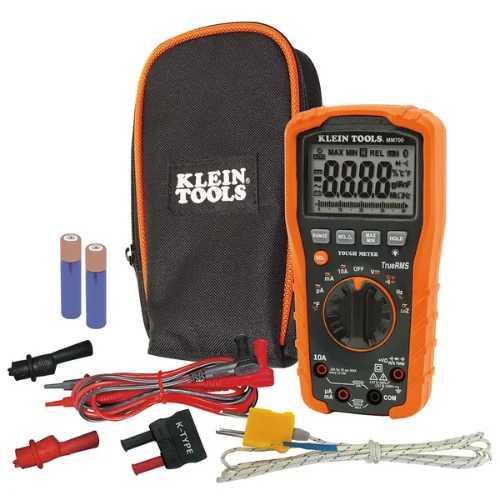
The Klein Tools MM700 Multimeter is a powerful tool designed with electricians in mind. It features automatic ranging true root mean square (TRMS) technology, allowing for enhanced accuracy in measuring AC/DC voltages, AC/DC currents, resistance, temperature, capacitance, frequency, and duty cycle. In addition, it can also test diodes and continuity.
With its CAT IV 600V safety rating, this multimeter is perfect for professional electricians due to its reliable performance and combination of features. Klein Tools MM700 Multimeter is the ultimate choice for any technician. Its durability is unmatched – it can take a 6.6-foot drop and withstand daily wear and tear on the job site.
Specifications:
- Display Counts: 4000
- Auto/Manual ranging: Yes
- AC/DC Voltage measuring range: 600V
- AC/DC Current measuring range: 10A
- Resistance: 40MOhms
- Frequency: 1Hz – 500 KHz
- Capacitance: 1000 μF
Features:
- Advanced TRMS Technology: Guarantees accurate readings for all electrical properties.
- Rugged Construction: Endures drops and tough work environments.
- Low Impedance (LoZ) Mode: Identifies and eliminates ghost voltages.
- Multi-Function Capability: Measures voltage, current, resistance, and more.
- Clear Display: Features a reverse contrast display for enhanced visibility.
What Works?
- I noticed the automatic ranging feature, which made measurements more convenient and less time-consuming during my testing.
- In my personal trial, the multimeter’s build quality impressed me, as it’s clearly built to withstand tough environments and rough handling.
- My hands-on research revealed the low battery indicator, which is a handy feature, ensuring I’m never caught off guard with a dead battery.
- I also appreciated the easily accessible battery, making it simple to replace without any hassle.
What Doesn’t?
- I did notice that the supplied test leads didn’t quite meet the usual Klein standards. They felt a bit less durable than I expected.
Package Includes:
- Klein Tools MM700 Multimeter
- Protective Carrying Case
- Test Leads
- Batteries
Why It Matters?
I opted for the Klein Tools MM700 Multimeter for its combination of precision and ruggedness, which I found perfect for demanding job sites and intricate electrical diagnostics. The advanced features and robust construction ensure that it performs reliably, even in tough conditions. While the test leads were a slight letdown, everything else about the multimeter made it a solid choice for professionals who need dependable tools on the job.
3. Triplett MM525 Digital Multimeter “Best for Engineers”

The Triplett MM525 digital multimeter offers an unparalleled degree of accuracy, convenience, and functionality. It features a range of 4 different measurements, including AC/DC Voltage, AC/DC Current, Resistance, Temperature, and much more. Additionally, its True RMS readings ensure unparalleled accuracy when measuring non-sinusoidal or noisy waveforms.
The EBTN (Enhanced Black Twisted Nematic) display with 31 segments analog bar graph gives you crystal clear readouts anytime. Other features include Lo Z (impedance) mode for identifying ghost voltages, Low Pass Filter (LPF) for filtering frequency interference, and Data Hold for freezing the currently displayed value.
Specifications:
- Display Counts: 6000
- Auto/Manual ranging: Yes
- AC/DC Voltage measuring range: 1000V
- AC/DC Current measuring range: 10A
- Resistance: 60MOhms
- Frequency: 0.001Hz to 10MHz
- Capacitance: 10pF to 4000μF
Features:
- Low Impedance (LoZ) Mode: Reduces ghost voltages for more accurate measurements.
- Low Pass Filter (LPF): Filters out high-frequency noise in motor drives.
- Data Hold & Relative Mode: Captures readings and compares them to set standards.
- Non-Contact Voltage (NCV) Detection: Enhances safety by detecting voltage without contact.
- Rugged Overmolded Design: Offers increased durability and ergonomic handling.
What Works?
- The True RMS feature stood out to me, providing accurate readings, particularly when working with non-linear signals.
- During my testing, I found that the Triplett MM525 is well-suited for a variety of industrial and residential applications, making it a versatile tool for different tasks.
- The multimeter offers a variety of measurements, which I found really helpful when handling diverse electrical testing needs.
- The rubberized over-molded housing impressed me, adding extra durability and a secure grip, especially when using it for extended periods.
What Doesn’t?
- It became evident to me that the multimeter can be a bit slow in some modes, which might be an inconvenience during fast-paced tasks.
Package Includes:
- Triplett MM525 Digital Multimeter
- Test Leads
- Temperature Probe
- Pouch Case
- AAA Batteries (3)
Why It Matters?
The Triplett MM525 Multimeter caught my attention because of its superior performance and versatility. With its True RMS feature and robust rubberized housing, it’s built to deliver reliable results in a variety of environments. While it can be slow in some modes, its overall reliability and ease of use make it a strong choice for precise measurements.
4. KAIWEETS Digital Multimeter “Best Budget Multimeter“

The KAIWEETS Digital Multimeter is perfect for anyone looking for a reliable and easy-to-use measuring tool. This sleek and modern model is equipped with an upgraded LCD color display, along with a flashlight that makes taking measurements even easier in both bright and dim lighting scenarios.
The multimeter also displays an analog bar, and real-time temperature readings have a low battery prompt. It features a damaged fuse prompt, making this one of the most all-inclusive digital multimeters on the market today. The KAIWEETS Digital Multimeter is a technologically advanced device that is suitable for diagnosing automotive, industrial, and household electrical problems.
Specifications:
- Display Counts: 10000
- Auto/Manual ranging: Yes
- AC/DC Voltage measuring range: 1000V
- AC/DC Current measuring range: 10A
- Resistance: 9.999MΩ
- Frequency: 9.999MHz
- Capacitance: 99.99mF
Features:
- Smart Measurement Mode: Automatically identifies and measures with optimal precision.
- Rechargeable Battery: Provides extended use and reduces the need for frequent replacements.
- Enhanced Visibility: Large color display and built-in flashlight for working in low-light.
- Comprehensive Safety: Equipped with double fuse anti-burn and overload protection.
- Versatile Functionality: Measures a wide range of electrical parameters with additional environmental readings.
What Works?
- The smart and manual modes gave me the flexibility to switch between convenience and control, depending on what the job required.
- From my experience, it felt safe and reliable throughout my testing—something I value highly when working with electricity.
- I found the sound and light alarm especially useful for quick alerts, making it easier to spot issues without needing to stay glued to the screen.
- The display was easy to read, even in different lighting conditions, which made my work faster and more efficient.
What Doesn’t?
- I did feel it’s a bit pricey compared to other models in its category, though the features help justify the cost.
Package Includes:
- KAIWEETS KM601s Digital Multimeter
- Test Leads
- Charging Cable
- Thermocouples
- Batteries
- User Manual
- Storage Case
Why It Matters?
I went with the KAIWEETS KM601s because of its intelligent design and all-in-one feature set that makes electrical diagnostics simpler and safer. It’s more than just a multimeter it’s a dependable companion that brings precision, versatility, and peace of mind. Whether I’m handling quick checks or detailed troubleshooting, this compact device has proven to be a smart investment.
5. AstroAI Digital Multimeter “Best for Home use“

The AstroAI Digital Multimeter offers accurate, reliable performance and is suitable for various applications. It features a range of functions such as AC/DC Voltage, Current, Resistance, Continuity, Capacitance, Frequency, Diodes, and Temperature measurement. The LED Intelligent Jack makes it easy to use in dimly lit environments with the choice of backlight or flashlight mode.
Additionally, this DMM has non-contact voltage testing and sound and light alarm for added safety when working with outlets, sockets, terminals, and more. It has passed rigorous overvoltage category III 600V CE standards, as well as an anti-burn double ceramic fuse and a thermistor protection circuit for optimum protection from overload on all ranges.
Specifications:
- Display Counts: 6000
- Auto/Manual ranging: Yes
- AC/DC Voltage measuring range: 1000V
- AC/DC Current measuring range: 10A
- Resistance: 60MOhms
- Frequency: 0~60MHz
- Capacitance: 60mF
Features:
- Smart LED Jacks: Directs users to the correct input with flashing lights.
- Enhanced Visibility: Large backlit LCD and built-in flashlight for dim areas.
- Safety Focused: Non-contact voltage testing with visual and audible alerts.
- Comprehensive Functionality: Includes max/min data, data hold, auto power-off, and more.
- Robust Protection: Double ceramic fuse and overload protection for durability.
What Works?
- I found the AstroAI Multimeter 6000 useful across a wide range of applications—it handled everything from household outlets to more complex diagnostics without a hitch.
- Its smart functions really stood out to me, making measurements quicker and reducing the chances of error during testing.
- I felt confident using it thanks to the built-in safety design, which gave me peace of mind during hands-on tasks.
- The LED intelligent jack was a nice touch it guided me clearly on where to plug in the leads, especially helpful when multitasking.
What Doesn’t?
- The only downside I noticed is that it’s a bit big in size, which made it slightly less convenient to carry around or fit into tighter toolkits.
Package Includes:
- AstroAI 6000 Digital Multimeter
- Test Leads
- User Manual
- Silicone Protective Case
Why It Matters?
I chose the AstroAI Multimeter 6000 because it strikes a solid balance between functionality and safety. With its smart features, strong safety design, and user-friendly interface, it’s become one of my go-to tools for electrical tasks. Even though it’s a little bulky, the added visibility and performance make it well worth the space in my toolkit.
How To Choose The Best Multimeter For Solar Panels
Choosing the best multimeter for solar panels is a critical process and can make or break your injury when obtaining accurate readings. Multimeters are used to measure electricity in solar panel systems, allowing you to monitor performance and detect issues quickly.
When selecting a multimeter, there are several important factors to consider that will help you get the most out of your purchase. With many options on the market, here is what you should keep in mind:
1. Digital vs analog multimeters
Analog meters tend to be cheaper but less accurate than digital models, so if precision matters, then opt for digital types instead. Depending on the complexity of your electrical system, different features may be required – such as temperature measuring or frequency metering capabilities, which can be found on more advanced digital meters.
2. Functionality
Consider the type of measurements needed before selecting a meter; some require specific ranges while others have an auto-ranging ability which makes selection easier since they automatically configure their settings depending on what’s being tested.
Also, ensure that if an external power source is needed (AA batteries), these are included with the unit; otherwise, additional expenditures will need to be made upon purchase time
3 Range Selection
Types of readings obtained from a solar panel system include current (amperage), voltage (volts), and resistance (ohms). Each has its own range requirements, which depend on the size of your system i.e, small home systems use low voltage/low currents, while larger commercial projects require higher voltages/current ranges.
4 Safety Features
Look for safety features such as insulation protection against electric shock or overload protection, which prevents damage during readings if extreme values are detected
5 Durability
Due to their regular usage outdoors, check for materials used in construction, such as rubber grips and protective cases made from a rubber material that resists water ingress.
By taking into consideration all these features when choosing a multimeter for solar panels, you can rest assured knowing that you will get accurate results every time with minimal risks associated with use.
Reasons to Use a Multimeter for Solar Panels
Solar panels are a fantastic way to generate clean, renewable energy. However, like any electrical system, they can experience issues over time. A multimeter is a versatile and affordable tool that can be incredibly helpful in diagnosing problems with your solar panels. Here are some key reasons why you should consider using a multimeter for your solar panels:
1. Performance Monitoring
- Track Power Output: A multimeter allows you to measure the voltage (measured in volts) and current (measured in amps) produced by your solar panels. By comparing these readings to the panel’s specifications, you can assess if your panels are performing as expected. Deviations from the expected values could indicate potential problems such as dirt buildup, degradation, or faulty connections.
- Identify Performance Decline: Regularly monitoring voltage and current output over time allows you to identify any gradual decline in your solar panel’s performance. This early detection can help you address the issue promptly, preventing further energy loss and maximizing your system’s efficiency.
2. Troubleshooting Issues
- Isolating Faulty Components: A multimeter can be used to isolate faulty components within your solar system. By measuring voltage and current at different points in the circuit, you can pinpoint where the issue might lie. For example, a significant drop in voltage between the panel’s output and the inverter could indicate faulty wiring or a malfunctioning inverter.
- Diagnosing Connection Problems: Loose or corroded connections can significantly impact your solar panel’s performance. Using a multimeter to check for continuity (ensuring a complete circuit) in cables and connectors can help identify these issues.
3. System Maintenance
- Verifying Battery Health: If your solar system utilizes batteries for energy storage, a multimeter can be used to check their health. By measuring voltage, you can determine if the batteries are properly charged and identify potential issues like a failing battery cell.
- Ground Fault Detection: A multimeter can be used to check for ground faults, which occur when electricity leaks from the system’s live wires to the ground. This can be a safety hazard and can also reduce the efficiency of your solar system.
4. Cost-Effective Solution
- Affordable Tool: Compared to specialized solar panel testers, multimeters are a relatively inexpensive investment. This makes them a cost-effective option for homeowners and even some small businesses to diagnose basic solar panel issues.
- Versatility Beyond Solar: The beauty of a multimeter lies in its versatility. This one tool can be used for various electrical troubleshooting tasks around your home, not just for your solar panels. This translates to long-term value beyond solar maintenance.
5. Understanding Limitations
- Basic Troubleshooting: It’s important to understand that a multimeter is a basic troubleshooting tool. While it can identify many common issues, complex problems might require a professional solar technician equipped with more advanced diagnostic equipment.
- Safety Precautions: Working with electricity always requires caution. Ensure you understand proper safety procedures before using a multimeter on your solar system. Always consult the user manual for your specific multimeter and follow best practices for electrical safety.
6. Additional Considerations
- Multimeter Selection: For solar panel applications, a basic multimeter with DC voltage and current measurement capabilities will suffice. However, some models offer additional features like continuity testing and diode testing, which can be helpful for more advanced troubleshooting.
- Solar Panel Specifications: Always refer to the manufacturer’s specifications for your solar panels. These specifications will provide the expected voltage and current output values under different light conditions. This information is crucial for interpreting the readings obtained from your multimeter.
By incorporating a multimeter into your solar system maintenance routine, you gain valuable insights into the health and performance of your panels. This allows for early detection of problems, proactive maintenance, and ultimately, a more efficient and productive solar energy system.
Bottom Line
There you have it, the best multimeter for solar panels on the market. We’ve tested them all so you can make an informed decision and choose the right one for your needs. Whether you need a simple and easy-to-use model or a more advanced unit with more features, we’re confident that one of these will be perfect for you. So get out there and start measuring those solar panels!
FAQs
1. What is the best multimeter for solar panel testing?
The Fluke 115 is highly recommended for solar panel testing due to its accuracy and reliability. For a more affordable option, the KAIWEETS Digital Multimeter offers great value without compromising quality.
2. Are digital multimeters suitable for solar panel installations?
Yes! Digital multimeters, like the Klein Tools MM700 and Triplett MM525, are perfect for testing solar panels. They provide precise readings for voltage, current, and resistance—essential for any installation or troubleshooting.
3. What features should I look for in a multimeter for solar panels?
When choosing a multimeter for solar panels, look for features like auto-ranging, DC voltage measurement, and high accuracy. Models like the AstroAI Digital Multimeter offer all these features at an affordable price.
4. Can a budget multimeter be used for solar panel testing?
Absolutely! Budget multimeters like the KAIWEETS Digital Multimeter can still provide accurate readings for solar panel systems. While they may lack some advanced features, they’re perfect for routine tasks and home use.